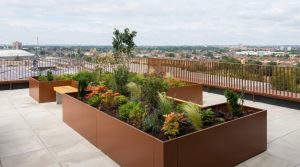
A metal planter is the most practical and durable choice for any terrace in the UK. It does not crack in frost, does not rot in rain, and does not fade under years of sun and wind. On a residential patio, a city balcony, or a commercial rooftop terrace, metal planters bring structure, colour, and greenery to an outdoor space in a way that almost no other container material can match.
Terrace planters in the UK have become a serious design consideration rather than an afterthought. Architects specify them. Landscape designers plan full planting schemes around them. Developers fit them into high-rise amenity terraces as a compliance and design requirement. And across all of these settings, the metal planter consistently performs better and looks better over time than timber, fibreglass, terracotta, or plastic alternatives.
At Metal Planters Ltd, based in Chelmsford, Essex, we design and fabricate metal planters for residential terraces, flat-roof extensions, commercial rooftop terraces, hotel forecourts, and public realm spaces across the UK. This guide covers everything you need to know about choosing, specifying, and installing metal terrace planters in 2026.
What Is a Metal Planter for a Terrace?
A metal planter is a container made from fabricated sheet metal, designed to hold growing medium and plants in outdoor or indoor environments. Unlike moulded containers, a metal planter is cut, folded, and welded from flat sheet material. This makes almost any size, shape, or profile achievable without expensive tooling.
On a terrace, the metal planter serves multiple functions. It contains the planting and growing medium. It defines the edges, zones, and focal points of the outdoor space. It contributes to the architectural character of the terrace, particularly when the material and colour are coordinated with the building’s palette. And in commercial and public settings, it can perform practical roles: managing foot traffic, providing privacy screening, or acting as a physical barrier.
The materials most commonly used for terrace planters in the UK are mild steel (usually powder-coated), aluminium (usually powder-coated), and corten weathering steel. Each has a different set of characteristics, and the right choice depends on the terrace type, load constraints, aesthetic brief, and budget.
Why terraces need purpose-made planters
Standard garden pots and decorative containers are not designed for the specific conditions of a terrace, particularly a raised or rooftop terrace. Wind is more intense at height. Sun is more direct. Temperature swings are greater. And on a flat roof terrace, the structural load of the planter, growing medium, and plants must be calculated carefully against the structural capacity of the roof slab.
A purpose-made terrace metal planter addresses all of these challenges. It is specified at the correct gauge for the application, designed with drainage appropriate to the terrace surface, available in lightweight aluminium for load-sensitive rooftop sites, and available in fire-compliant materials for regulated building types.
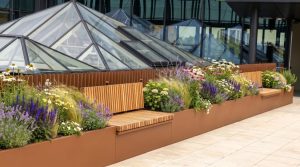
Types of Metal Planter for Terrace Use
There are several distinct types of metal planter for terrace use, and each type suits a different part of the space or a different design intent.
Rectangular trough terrace planters
The trough is the most widely used format for terrace planters. Its long horizontal form creates a continuous planted line that reads as a design feature rather than a collection of individual containers. Troughs are used along terrace boundaries for privacy screening, along the edges of raised decks, as zone dividers in larger spaces, and as feature planting around seating areas.
Long low troughs also have a practical wind advantage on exposed terraces. They present a lower profile to the wind than tall individual planters, which reduces the risk of overturning and reduces the structural wind load on the terrace surface.
Square and cube terrace planters
Square cube planters are the most versatile terrace planter format. They work as entrance markers flanking a door or gate, as symmetrical pairs on either side of a seating area, in rows along a path or boundary, or as solo statement pieces planted with a specimen shrub or standard tree.
On residential terraces, 400mm to 600mm square planters are the most common size range. For commercial and rooftop terrace schemes, 700mm to 1000mm square planters are more appropriate in scale.
Tall column terrace planters
Tall column planters create vertical interest on a terrace that lower containers cannot provide. For framing entrances, creating visual height against a low boundary wall, or introducing a vertical accent to a predominantly horizontal terrace design, tall column planters in 800mm to 1200mm heights are highly effective.
Stability is the key consideration with tall terrace planters. On exposed roof terraces, tall column planters need ballasting in the lower section or fixing to the surface. Metal Planters Ltd advises on fixing details and ballasting strategy on a project-specific basis.
Raised bed terrace planters
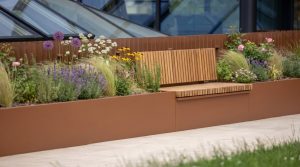
Metal raised beds are increasingly popular on residential terraces, particularly for kitchen herb gardens and food growing. A raised bed at 600 to 800mm height makes planting, tending, and harvesting genuinely comfortable without kneeling. Corten steel raised beds on a terrace pair well with brick, timber, and render surfaces due to the warm tone of the rust patina.
Wall-mounted terrace planters
Wall-mounted planters suit compact terraces and balconies where floor space is limited. Aluminium wall-mounted planters are light enough to fix to most masonry walls with standard stainless steel fixings. They are effective for herb growing, trailing plants, and adding a planted element to otherwise blank terrace walls and fences.
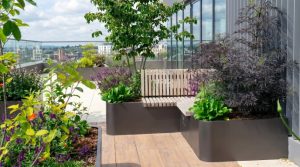
Aluminium vs Steel vs Corten Metal Planter: Which Is Right for Your Terrace?
Choosing between aluminium, steel, and corten steel for a terrace metal planter is the most important specification decision you will make. Here is a straight comparison.
|
Factor |
Aluminium |
Powder-coat Steel |
Corten Steel |
|
Aesthetic finish |
Any RAL colour, stays consistent |
Any RAL colour |
Living rust patina, warms with age |
|
Weight at 3-4mm gauge |
Lightest ~11 kg per m2 (4mm) |
Heavy ~23 kg per m2 (3mm) |
Heavy ~23 kg per m2 (3mm) |
|
Rust resistance |
Excellent – natural oxide layer |
Good while coating is intact |
Self-protective stable patina |
|
Maintenance required |
None |
None if coating is undamaged |
None once patina is established |
|
Fire classification |
A2-s1,d0 non-combustible |
A2-s1,d0 |
A2-s1,d0 |
|
Roof terrace suitability |
Excellent – lowest dead weight |
Check engineer for heavy loads |
Check engineer for heavy loads |
|
Staining risk |
None |
None |
During initial weathering only |
|
Colour options |
Any RAL classic |
Any RAL classic |
Natural pre-weathered rust only |
|
Typical lifespan |
30 or more years |
20 to 30 years |
40 or more years |
|
Relative price |
Mid to high |
Mid |
Mid to high |
Aluminium terrace metal planter
Aluminium is the correct choice for roof terraces, balconies, and any elevated terrace where the structural dead load is a genuine constraint. It weighs roughly one third as much as equivalent steel or corten, which allows more planting within a given load budget. It does not rust. Any scratch through the powder coat reveals more aluminium, not a surface that will then corrode.
Our 4mm aluminium terrace planters provide the rigidity needed for large commercial formats while keeping dead weight as low as practically achievable. All are available in any RAL colour powder-coated finish, with batch-matching across all units in a scheme for colour consistency.
Steel terrace metal planter
Steel at 3mm gauge is the strongest option and the most cost-effective at mid-scale. It is the most widely specified material for commercial terrace planters and public realm applications where physical robustness and value matter most. The powder-coat finish is available in any RAL colour, and the weight of filled steel planters adds inherent stability on ground-level and low-level terraces.
Corten terrace metal planter
Corten steel is the design choice that consistently gets the most positive responses when the finished terrace photographs are taken. The warm, layered rust-and-bronze patina cannot be replicated in paint or powder coat, and it improves with every year of outdoor exposure. For residential terraces, private gardens, and any landscape scheme where an organic, naturalistic aesthetic is part of the brief, corten is consistently the most rewarding material.
Metal Planters Ltd supplies all corten terrace planters pre-weathered as standard. This means the heaviest phase of initial rust water runoff has already occurred before delivery. The risk of staining light-coloured paving is significantly reduced from day one.
|
If your terrace is at roof level, always choose aluminium for the metal planter unless a structural engineer has confirmed adequate capacity for heavier steel. For a ground-level residential terrace with a naturalistic design scheme, corten is the most visually rewarding choice. For a commercial terrace where impact resistance and colour consistency are the priorities, specify powder-coated steel. |
Where to Use a Metal Planter on Your Terrace
Positioning matters as much as material choice. A well-placed terrace metal planter anchors a space and makes it feel designed. A poorly positioned planter just takes up room. Here are the positions that work most reliably.
Along the terrace boundary edge
Placing a row of trough planters along the boundary edge of a terrace is the most effective design move available. It creates a soft planted perimeter that defines the space, provides privacy and wind screening when planted appropriately, and softens the hard line of the boundary wall or balustrade. On a roof terrace, boundary trough planters planted with Calamagrostis or Fargesia bamboo can reduce the effective wind exposure of the seating area by a meaningful amount.
Flanking doorways and terrace access points
A pair of matching metal planters either side of a door, gate, or step onto a terrace creates an arrival moment. It signals that the space is designed. For residential terraces, cube planters in 500 to 600mm in a consistent material and colour are the right scale for most standard doorways. For commercial entrances, larger 700 to 900mm cubes are more appropriate.
Creating zones within a larger terrace
On a terrace of 30 square metres or more, a single open surface quickly becomes featureless and difficult to use effectively. Metal planters can be arranged to create distinct zones: a planted boundary area, a dining space, a seating lounge area. Trough planters placed at right angles or in an L-configuration create soft room dividers that define the zones without blocking views or closing the space down.
Balconies and compact urban terraces
For apartment balconies and compact urban terraces, aluminium is the right metal planter material. The RHS guidance on roof gardens and balconies recommends non-porous materials, including metal, for container planting on elevated sites. Metal containers retain moisture better than terracotta in the drier and more exposed conditions typical of high-level urban terraces, and aluminium keeps the dead load low enough to be safe on most balcony slabs.
Raised terrace areas and split-level designs
On split-level terraces, where a raised deck meets a lower paved area, metal planters placed at the transition create a visual anchor. A pair of tall column planters or a pair of large cubes at the top of the steps between levels marks the change in level, makes the transition feel deliberate, and contributes to the vertical composition of the space.
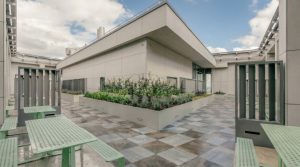
Benefits of a Metal Planter on a Terrace
There are concrete practical reasons why metal planters dominate the terrace planter market in the UK. Here is the honest case.
- Maintenance-free in outdoor use: Powder-coated metal terrace planters need no annual treatment. A wipe-down with a damp cloth once or twice a year is genuinely all the maintenance required.
- Bespoke sizing at no tooling cost: Because metal planters are fabricated rather than moulded, any dimension and almost any shape can be produced without mould costs. This makes a bespoke size to fit your specific terrace layout as straightforward to order as a standard size.
- Consistent colour across a scheme: Batch powder-coating ensures every planter in a terrace scheme is in exactly the same colour. This is practically impossible to guarantee with timber, stone, or terracotta at reasonable cost.
- Fire compliant for regulated buildings: Both aluminium and steel terrace planters achieve A2-s1,d0 classification under BS EN 13501-1. This is the non-combustible classification required for external materials on residential buildings above 18m and on most commercial buildings.
- Lightweight aluminium for roof terraces: 4mm aluminium terrace planters weigh roughly half the dead load of equivalent 3mm steel planters. For roof terrace applications where the structural engineer has set a maximum load per square metre, this is often the key enabler for the planting scheme.
- Long service life: Aluminium terrace planters last 30 or more years. Corten steel terrace planters last 40 or more years. The long-term cost per year of use compares very well against timber or fibreglass alternatives that need replacing within ten to fifteen years.
- Frost-proof: Metal terrace planters do not crack in freezing temperatures. This is a genuine and consistent failure mode for terracotta in UK winters and is completely absent from metal planters.
- Architectural aesthetic: A well-specified terrace metal planter signals a designed space in a way that plastic, budget resin, or off-the-shelf terracotta simply cannot. The visual quality of metal raises the perceived value of the whole terrace.
Terrace Planter Design Ideas for 2026
These are the terrace planter combinations that are being most widely specified in UK landscape architecture and residential garden design in 2026. They are not trend-chasing ideas. They are combinations that work well in the long term.
Corten trough planters with ornamental grass along a terrace boundary
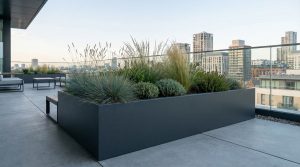
This is probably the most widely specified terrace planting combination in UK contemporary landscape design right now. Large corten steel troughs, pre-weathered, in lengths from 1000 to 1500mm, planted with Calamagrostis ‘Karl Foerster’ or Stipa gigantea at close spacing. The warm tones of the corten patina and the movement of the ornamental grass in wind create a composition that looks good in all seasons and requires almost no maintenance once established.
The trough planters sit along the boundary edge of the terrace, creating screening and wind protection while allowing light and views through the open heads of the grasses. This combination works on residential garden terraces, flat-roof extensions, and commercial outdoor hospitality spaces.
Anthracite aluminium cubes flanking a glass door
Two 600mm square cube planters in RAL 7016 anthracite powder-coated aluminium, placed symmetrically either side of a large-format glass door onto a terrace, each planted with a single trained standard lollipop Photinia Red Robin. This is a simple, precise, and highly effective entrance composition. The anthracite matches most contemporary aluminium glazing systems. The formal symmetry of the standard trees creates a proper arrival moment.
This works equally well on residential rear terraces, commercial entrance forecourts, and hotel terrace access points.
Mixed height composition for a residential terrace
A three-element composition: two 600mm cube planters in corten steel flanking the terrace door, planted with clipped box balls; one 1400mm long by 500mm wide corten trough planter along the side boundary, planted with a mixed combination of Agapanthus, Echinacea, and Festuca glauca; and one tall 300mm by 300mm by 900mm corten column planter in the corner, planted with a single upright ornamental grass. All in the same pre-weathered corten finish. The result reads as a considered, complete planting scheme rather than a collection of individual pots.
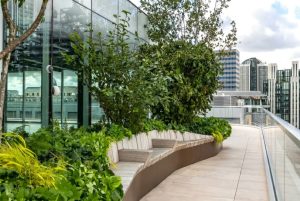
Metal Planter Installation Guide for Terraces
This step-by-step guide covers the standard installation approach for a terrace metal planter. It applies to both residential and commercial terraces. For roof terrace installations involving adjustable pedestals or structural engineering sign-off, additional project-specific guidance applies.
Before you begin: planning and safety
Plan the final position of every planter before anything is delivered. A large metal terrace planter filled with growing medium is very heavy and very difficult to reposition. On a roof terrace, confirm the dead load capacity with a structural engineer before committing to the planter specification. For working at height on scaffolding or edge-protected terraces, follow all relevant HSE guidance on safe working at height.
Step 1: Position and level the planter
Place the planter in its final position. Use a spirit level to confirm it sits level. The planter feet should all be in contact with the surface. On uneven paving, thin packers under individual feet can correct minor variations. A level planter ensures water drains toward the base holes rather than pooling in a corner.
On a flat roof terrace, place the planter on adjustable pedestals above the waterproofing membrane. Never place a terrace metal planter directly on a flat roof membrane. This protects the membrane from point loading, maintains the drainage fall beneath the planter, and prevents moisture from being trapped between the planter base and the membrane.
Step 2: Add the drainage layer
Pour a 50 to 75mm layer of drainage aggregate into the base of the planter. Washed 10 to 20mm gravel is the standard choice for ground-level terraces. For roof terraces and balconies where dead weight must be minimised, use expanded clay balls (LECA) or perlite. These provide equivalent drainage at 60 to 70 percent less weight per volume.
Lay a cut piece of geotextile membrane over the drainage aggregate. This allows water to drain freely through while preventing fine growing medium particles from washing into the aggregate and blocking the drainage holes over time.
Step 3: Choose and add the growing medium
For standard ornamental terrace planting, a 70/30 mix of multipurpose compost and horticultural grit drains well and provides adequate nutrition. For trees and large shrubs that will remain in the planter for several years, use a loam-based compost such as John Innes No. 3. This does not collapse and compress over time the way peat-free multipurpose compost does in a container.
For roof terrace and balcony applications, use a specialist lightweight container compost. These mixes weigh approximately 50 percent less than loam-based compost when saturated.
Step 4: Plant up and mulch
Remove the plant from its nursery pot and gently loosen any tightly circling roots at the base of the root ball before planting. Position the root ball so the top sits 25 to 30mm below the rim of the planter. This leaves room for watering without water spilling over the edge. Backfill and firm gently around the root ball.
Apply 30 to 50mm of decorative mulch over the growing medium surface. Bark chips, slate chippings, or dark gravel all work well. Mulch reduces moisture loss from the growing medium surface, which matters more on an exposed terrace than in a sheltered garden.
Step 5: Water in and verify drainage
Water the newly planted container thoroughly. Check that drainage begins from the base holes within one to two minutes of a full application of water. If drainage is slow, probe the holes gently from below with a thin stick to confirm they are not blocked by aggregate or membrane material.
After the first significant rain, check the growing medium surface. It should not remain visibly waterlogged more than a few hours after heavy rain. Persistent surface waterlogging usually means the drainage holes are partially blocked or the drainage layer has not been installed correctly.
|
On flat roof terraces and balconies, always obtain structural confirmation of the dead load capacity before placing large planted metal planters. Filled metal terrace planters can easily weigh 150 to 200kg or more when the growing medium is saturated. Multiple large planters on a flat roof add up to a significant total load. Use 4mm aluminium planters with lightweight specialist growing medium to reduce load where possible. |
|
Maintenance: powder-coated metal terrace planters need no annual treatment. Check drainage holes are clear in autumn after leaf fall. On corten steel terrace planters, check that rust runoff during the first season is not pooling in any area that could cause persistent staining, and ensure drainage from the base holes runs away freely from the paving surface. |
What to Plant in a Terrace Metal Planter
The right plant for a terrace metal planter depends on the size of the container, the site exposure, the aesthetic intent, and whether the terrace is mainly residential or commercial. Here are the most reliable choices for UK terrace conditions.
Year-round structure
- Calamagrostis ‘Karl Foerster’: Upright, architectural, and perennial. One of the most consistently effective choices for trough planters on UK terraces. Holds its form through winter and moves well in wind.
- Clipped box (Buxus sempervirens): Classic formal planting for square terrace planters. Year-round evergreen structure. Works in anthracite steel or corten containers equally well.
- Phormium: Bold, spiky, and structural. Bronze-foliage varieties sit within the same colour palette as corten steel. Very tolerant of terrace exposure.
- Bay (Laurus nobilis) as a trained standard: Clipped formal standard bay in a square metal terrace planter is a consistently good-looking combination for residential terrace entrances and commercial hospitality settings.
Privacy and wind screening
- Fargesia murielae (clumping bamboo): Best privacy screening plant for tall trough planters on exposed terraces. Wind-tolerant, non-invasive, and fast-growing. Provides effective year-round screening at relatively low cost.
- Miscanthus sinensis ‘Strictus’: Upright ornamental grass reaching 2m or more with attractive banded foliage. Creates a tall, semi-transparent screen in a trough planter.
Seasonal flowering
- Agapanthus: Blue or white summer flowers. Strap-like evergreen leaves year-round. Does very well in the constrained root conditions of a terrace container.
- Echinacea: Warm orange and amber flowers in summer and autumn, within the same warm palette as corten steel. Long-flowering and reliably perennial in a UK terrace container.
- Lavender: Drought-tolerant, fragrant, and reliable. Suits south-facing terrace positions and well-drained container conditions.
Metal Planter for Commercial Terraces and Public Spaces
Commercial terrace planter specifications have requirements that go beyond residential projects. Fire compliance, structural load calculations, batch colour consistency, and installation to a programme that fits a wider construction schedule are all part of the brief for a commercial terrace project.
Hotel and hospitality terraces
Hotel and restaurant terrace planters are part of the guest experience. They need to look good year-round, withstand general public contact, and coordinate visually with the building’s architectural palette. Metal Planters Ltd produces detailed fabrication drawings for each commercial terrace planter, batch-coats all units in the same production run for colour consistency, and delivers to a programme.
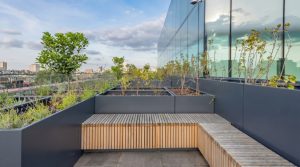
Large steel trough terrace planters in anthracite RAL 7016, planted with formal standard specimens, are the most commonly specified combination for hospitality terraces at the mid to high end of the market. These planters also serve as physical barriers controlling access to outdoor dining areas.
Residential rooftop amenity terraces
Rooftop amenity terraces on new residential developments in the UK are increasingly specified as genuine designed outdoor spaces, not just a paved area with a few pots. The planter specification is part of the architectural and landscape design package, and needs to meet fire compliance requirements for the building type.
Metal Planters Ltd supplies complete rooftop terrace systems that integrate the metal planter specification with the structural subframe, pedestal support system, drainage strategy, aluminium decking, and seating. Explore our rooftop terrace systems for full details of what a coordinated specification from Metal Planters Ltd involves.
Public realm and streetscape
Metal terrace planters and street planters in public realm settings need to be vandal-resistant, easy to maintain, and designed to a specification that has been reviewed and approved. Steel planters at 3mm gauge offer the physical robustness required for public settings. In larger formats, they can also serve as hostile vehicle mitigation features.
Browse our full metal planter product range to see the full selection of materials, sizes, and finish options for commercial terrace applications.
Terrace Planter Sizes and Costs in the UK
The costs below are indicative for 2026 planning purposes. Actual prices depend on material, gauge, exact dimensions, colour, and quantity. Contact Metal Planters Ltd for a specific quotation.
|
Terrace planter type and size |
Material |
Indicative price (inc. VAT) |
Notes |
|
Square cube 400x400x400mm |
3mm steel |
£160 – £240 |
Residential entrance pair |
|
Square cube 600x600x600mm |
3mm corten |
£200 – £300 |
Pre-weathered finish |
|
Square cube 600x600x600mm |
4mm aluminium |
£240 – £360 |
Roof terrace load-critical |
|
Trough 1000x400x400mm |
3mm corten |
£260 – £380 |
Boundary edge screening |
|
Trough 1500x500x500mm |
3mm steel |
£380 – £540 |
Commercial terrace barrier |
|
Trough 1500x500x500mm |
4mm aluminium |
£420 – £600 |
Rooftop light-weight trough |
|
Raised bed 1200x600x600mm |
3mm corten |
£360 – £500 |
Terrace kitchen garden |
|
Tall column 300x300x900mm |
3mm steel |
£220 – £340 |
Vertical accent planter |
|
Bespoke (any size or shape) |
Any material |
POA |
Quote within 24 to 48 hours |
To see the full range, visit the Metal Planters Ltd homepage or go directly to our planters product page. Call us on 01245 922332 or email sales@metal-planters.co.uk to discuss your terrace planter project.
Frequently Asked Questions About Terrace Planters
|
What is the best metal planter for a terrace? |
|
It depends on the terrace type. For a roof terrace, aluminium is the best metal planter because it weighs roughly one third as much as steel, which is important when structural dead load is a constraint. For a residential ground-level terrace with a naturalistic or contemporary design scheme, corten steel is the most visually rewarding choice. For a commercial terrace where impact resistance and colour consistency matter most, powder-coated mild steel is the best specification. All three materials achieve A2-s1,d0 non-combustible fire classification. |
|
How do I choose the right size terrace planter? |
|
The key principle is to use fewer, larger planters rather than many small ones. Two 600mm square cube planters will always look more designed than eight 300mm pots. Match the planter scale to the architectural scale of the terrace. On a terrace with 2.4m ceilings or overhead elements, a 600mm planter planted with a 1500mm tall grass reads as correctly proportioned. Trough planters at boundary edges should typically be at least 400mm wide and 400mm tall to have visual and structural presence. Contact Metal Planters Ltd for help sizing planters for your specific terrace dimensions. |
|
How much do terrace planters cost in the UK? |
|
Indicative prices in 2026 start from approximately £160 for a 400mm square steel cube planter and rise to £600 or more for large 1500mm aluminium trough planters. Corten steel planters in standard sizes are typically in the £200 to £380 range. Bespoke sizes are available from Metal Planters Ltd at no significant premium over standard sizes. Contact us for a specific quotation with your dimensions, material preference, and quantity. |
|
Are terrace metal planters suitable for high-rise buildings? |
|
Yes. Both aluminium and steel metal planters achieve A2-s1,d0 reaction to fire classification under BS EN 13501-1. This is the non-combustible classification required for external materials on residential buildings above 18m under Approved Document B. Timber, plastic, and fibreglass planters do not achieve this classification and should not be specified on high-rise terraces and balconies. |
|
How do I prevent corten steel terrace planters from staining my paving? |
|
Metal Planters Ltd supplies all corten terrace planters pre-weathered as standard, meaning the heaviest phase of initial rust water runoff has already happened before delivery. Additional practical steps include: raising the planter on feet for clearance so runoff flows away from the base; placing a 50 to 75mm border of dark gravel around the planter; using a rubber drip tray under the planter for the first few months; and rinsing paving promptly after wet weather during the initial weathering period. Once the patina has fully stabilised, ongoing runoff is negligible. |
|
Can I grow vegetables in a metal terrace planter? |
|
Yes. Metal terrace planters are safe for food growing, including corten steel. The trace elements released from weathering steel are within normal soil chemistry ranges and have no harmful effect on plants or people. Metal raised beds at 600 to 800mm height are ideal for kitchen herb gardens and vegetable growing on terraces. Good drainage setup, appropriate growing medium, and a south-facing or full-sun position will produce excellent results. |
|
What is the difference between a terrace planter and a standard garden pot? |
|
Standard garden pots are designed for general garden use in relatively sheltered conditions. Terrace planters, particularly for elevated or rooftop terraces, need to be specified for greater wind exposure, higher UV levels, potential structural load constraints, and in some cases fire compliance requirements. Metal Planters Ltd fabricates terrace planters to the correct gauge, with appropriate drainage for terrace surfaces, in fire-compliant materials, and available in the lightweight aluminium specification required for roof terraces. |
|
How long do metal terrace planters last? |
|
Aluminium terrace planters with an external-grade powder coat last 30 or more years. Corten steel terrace planters last 40 or more years through the self-healing mechanism of the rust patina. Powder-coated mild steel terrace planters last 20 to 30 years with an intact coating. All three significantly outlast timber, terracotta, and fibreglass alternatives in UK outdoor terrace conditions. |
Conclusion
Terrace planters are not a finishing touch. They are a structural and visual element of the outdoor space. Get them right and the terrace looks and feels like a genuinely designed room. Get them wrong, or choose the wrong material for the site, and the space never quite works the way it should.
A metal planter is the most reliable choice for a UK terrace in 2026. It does not rot, does not crack in frost, does not fade quickly, and is available in bespoke sizes without tooling cost. Aluminium for rooftops and load-sensitive sites. Corten for residential and naturalistic schemes. Steel for commercial impact and colour consistency. All three are maintenance-free in normal outdoor use and all three meet the fire compliance requirements that matter on regulated buildings.
Metal Planters Ltd fabricates all three materials at our workshop in Chelmsford, Essex. We are happy to discuss any project from a single residential terrace planter pair to a full commercial terrace scheme.
Visit the Metal Planters Ltd homepage to explore our full terrace planter range, or see our planters product page directly. Call us on 01245 922332 or email sales@metal-planters.co.uk.