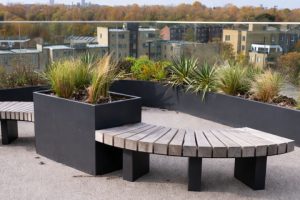
A metal planter is one of the most practical and long-lasting ways to bring plants into any outdoor space. Whether you need a sleek container for a city balcony, a large trough for a commercial entrance, or a corten steel raised bed for a productive kitchen garden, a metal planter delivers where most other materials fall short. They do not crack in frost, do not rot, and do not fade quickly. With the right specification they can last forty years or more with minimal effort.
At Metal Planters Ltd in Chelmsford, Essex, we design and fabricate metal planters for residential gardens, rooftop terraces, public realm schemes, and commercial developments across the UK and beyond. We have seen every common mistake buyers make and every question that gets asked before a purchase. This guide answers all of them.
We cover the different materials available, the shapes and sizes that work in specific settings, how to install a metal planter correctly, and what fire compliance requirements apply on regulated buildings. By the end of this guide you will have everything you need to specify or buy the right metal planter for your project.
What Is a Metal Planter?
A metal planter is a container made from fabricated sheet metal, used to grow plants outdoors or indoors. Unlike moulded products such as fibreglass or terracotta, a metal planter is made by cutting flat sheet into panels, folding or pressing them to shape, and welding the joints. This means the design can be altered to almost any size or form without a mould or tooling cost.
Metal planters are a firmly established material in UK landscape design. You will find them on residential patios and in hotel forecourts, on rooftop terraces and along commercial high streets, framing front doors and lining the edges of public parks. The range of looks is wide: a polished stainless steel cube outside a corporate office is a very different object from a pre-weathered corten steel raised bed in a cottage kitchen garden, but both are metal planters.
Why metal planters became so popular in the UK
Timber planters were the standard choice for much of the twentieth century. They are still widely used, and in the right setting they look good. But timber requires maintenance: painting or oiling every few years, replacing rotted sections, and eventually the whole container. For a busy homeowner or a commercial property manager, that ongoing cost and effort adds up.
Metal planters changed the conversation. They need no annual treatment. They do not rot, crack in frost, or warp in damp conditions. The powder-coat finish on a quality steel or aluminium planter is rated for twenty or more years without fading. And modern fabrication means bespoke sizes are achievable at reasonable cost, which matters enormously when you are fitting planters into a specific architectural setting.
The other shift is design. The clean geometric lines of a metal planter suit the contemporary aesthetic that dominates residential and commercial architecture in the UK today. The warm, organic patina of corten steel suits the naturalistic planting styles that landscape designers have embraced in the last decade. Metal planters look right in a way that plastic containers rarely do, and they look right for much longer.
Types of Metal Planter
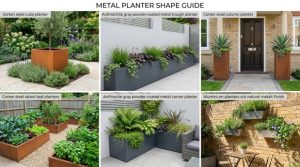
The shape of a metal planter determines how it reads in a space, what it can be planted with, and how stable it is in different conditions. Understanding the main types helps you choose the right form for your specific situation.
Square and cube metal planters
Square planters are the most versatile form. They work in pairs to frame an entrance, as single statement pieces on a terrace, or in rows along a boundary or path. A cube planter, where the height and width are roughly equal, reads as bold and deliberate. It creates a sense of permanence and weight that lower containers do not.
For residential use, a 400mm to 600mm square planter is the most common choice. For commercial landscape schemes, sizes from 700mm to 1000mm square and larger are standard. A corten steel cube planted with a clipped box ball or a standard bay tree is one of the most consistently good-looking combinations in UK contemporary garden design.
Rectangular trough metal planters
Trough planters are the workhorse of commercial and high-end residential schemes. The long horizontal form creates a continuous planted line that reads as a designed feature rather than a collection of individual pots. Troughs define zones, line the edges of terraces, and frame planted borders.
For roof terraces and balconies in exposed positions, long low trough planters have a practical advantage too. They present a lower profile to the wind, which reduces overturning forces on the supporting surface. Standard trough lengths run from 800mm up to 2000mm, and modular systems allow seamless runs at any length for large commercial projects.
Tall column and tower planters
Tall column planters create vertical drama that cannot be achieved with shorter containers. A pair of tall corten steel columns planted with single-stem bamboo at the entrance to a building creates an instant strong impression. The key practical consideration is stability: tall planters in exposed positions need ballasting in the lower section or securing to the surface to prevent overturning in wind.
Raised bed metal planters
Metal raised beds are one of the fastest-growing segments in the UK metal planter market. A corten or powder-coated steel raised bed at 600 to 800mm height makes planting, weeding, and harvesting genuinely comfortable. Metal raised beds drain better than in-ground beds, warm up faster in spring, and create a clean, defined edge that is easy to maintain.
For food growing, corten steel raised beds are perfectly safe. The trace elements released from the weathering process are within normal soil chemistry ranges and have no harmful effect on plants or people. Corten raised beds are widely used in both domestic and commercial food production.
Wall-mounted and bespoke metal planters
Wall-mounted metal planters are ideal for compact spaces, balconies, and courtyard gardens where floor space is limited. Because aluminium is light, a well-sized wall-mounted aluminium planter can be fixed to most masonry with standard fixings and no structural concerns.
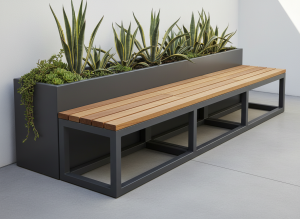
Bespoke metal planters cover any format that does not fit a standard shape: L-shaped corner planters, curved troughs, planters with integrated bench seating, long modular systems for commercial runs. Because metal planters are cut and welded rather than moulded, almost any geometry is achievable without tooling costs.
Aluminium vs Steel vs Corten Metal Planter
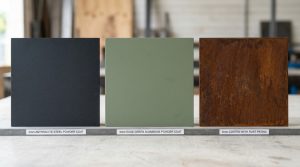
The three main materials used for metal planters in the UK are mild steel (including galvanised steel), aluminium, and corten steel. The differences between them are significant and worth understanding before you buy.
| Factor | Aluminium | Steel (powder coat / galv) | Corten Steel |
| Weight | Lightest – approx 11 kg/m2 at 4mm | Heavy – approx 23 kg/m2 at 3mm | Heavy – approx 23 kg/m2 at 3mm |
| Rust resistance | Excellent – natural oxide layer | Good with intact coating | Self-protective stable patina |
| Maintenance | None required | None if coating intact | None once patina established |
| Finish | Any RAL powder coat | Any RAL powder coat or galvanised | Natural rust patina (living finish) |
| Fire rating | A2-s1,d0 (non-combustible) | A2-s1,d0 | A2-s1,d0 |
| Roof terrace use | Best choice – lowest dead load | Check load with structural engineer | Check load with structural engineer |
| Aesthetic | Clean, modern, consistent colour | Industrial, sharp, any colour | Warm organic patina, evolves over time |
| Lifespan | 30+ years | 20-30 years with intact coating | 40+ years |
| Staining risk | None | None | During initial weathering period |
| Relative cost | Mid to high | Mid | Mid to high |
Aluminium metal planter: the full picture
An aluminium metal planter is the right choice when weight is a constraint. On a roof terrace or balcony where the structural engineer has set a maximum dead load per square metre, aluminium planters can weigh around one third as much as a steel equivalent. That is not a marginal saving: it can make the difference between a planting scheme being structurally feasible and not.
Aluminium does not rust. A scratch through the powder coat reveals more aluminium, not a surface that will then corrode. The finish stays consistent and the planter is genuinely maintenance free for its full service life. Metal Planters Ltd fabricates 4mm aluminium planters, which gives excellent rigidity for large commercial formats while keeping dead weight low.
Steel metal planter: the full picture
A steel metal planter offers the best combination of cost-effectiveness and structural robustness. At 3mm gauge, a steel planter is an extremely solid and rigid object. It can absorb impacts from vehicles or maintenance equipment that would dent a lighter material, which makes it the standard specification for commercial streetscape and public realm applications.
The powder-coat finish on a quality steel planter will last twenty or more years without fading. Galvanised finishes develop a soft weathered grey tone over time that suits industrial and contemporary settings. Metal Planters Ltd galvanised and powder-coated steel planters come with matching RAL colour coding across all elements, ensuring the colour is consistent across every planter in a scheme.
Corten metal planter: the full picture
A corten metal planter offers an aesthetic that no other material can match. The warm bronze and copper tones of the weathering patina develop gradually over six to twelve months outdoors and deepen over the years. A ten-year-old corten planter in a garden that has allowed it to weather naturally looks considerably richer and more considered than a new one. This evolving quality is the reason landscape architects and designers return to corten consistently.
The practical concern with corten is rust staining during the initial weathering period. During this phase, rust-coloured water runoff can stain pale porous paving, limestone, and sandstone. Metal Planters Ltd supplies all corten planters pre-weathered, which means the heaviest phase of initial runoff has already occurred before delivery, significantly reducing the staining risk from day one.
| If you cannot decide between corten and aluminium for a residential terrace project, consider this: aluminium gives you any colour and no staining risk at all. Corten gives you a warm, living finish that improves with age, but you need to plan for what sits underneath it during the first year. A simple gravel border around the base or pre-weathering on grass before final placement removes the practical concern completely. |
Where to Use a Metal Planter
Residential gardens and patios
In a residential garden, a metal planter works best when it is used with some restraint. Two matching corten steel cube planters flanking a gate or doorway. A row of three anthracite aluminium trough planters running along a rendered boundary wall, planted consistently with the same ornamental grass. A single large 800mm steel cube as a centrepiece on a paved terrace.
The key is simplicity. Metal planters have a visual confidence about them that is diluted by putting too many different shapes, sizes, and materials together in a small space. In a compact garden, two substantial well-placed metal planters will always look better than seven smaller ones in a variety of finishes.
Balconies and compact urban spaces
For balconies in apartment buildings, aluminium is the clear material of choice. It is the lightest metal option, which matters when balcony slabs often have tighter load limits than ground-level terraces. Wall-mounted aluminium planters take weight off the floor entirely. And aluminium powder-coated in anthracite or white looks sharp against the glass and rendered facades that characterise most modern urban residential buildings.
The RHS recommends non-porous materials such as metal for container planting on balconies and roof gardens, as they retain moisture better than terracotta and are more suitable for the exposed conditions typical of these sites. Metal planters meet this recommendation by definition.
Roof terraces
Roof terraces are where the specification decisions around metal planters become most complex. The planter choice connects to the structural dead load calculations for the roof slab, the fire compliance requirements for the materials in the external zone, and the drainage strategy for the terrace surface.
Metal Planters Ltd supplies complete rooftop terrace systems that integrate the metal planter specification with the structural subframe, pedestal system, drainage strategy, and seating. Planning the planters from the start of the terrace design avoids the common problems of late-stage load calculation failures or compliance gaps in the material schedule.
On buildings above 18m, all external materials including metal planters must achieve A2-s1,d0 or A1 classification under BS EN 13501-1. Both aluminium and steel achieve A2-s1,d0 as standard. This makes them fully compliant for high-rise terrace and balcony applications.
Commercial, hospitality and public realm
In commercial settings, a metal planter often does several jobs at once. It provides planted greenery that softens the hard surfaces of a commercial development. In larger formats, it controls vehicle access to pedestrian areas as a physical barrier. And in a hotel or hospitality setting, it communicates the quality and attention to detail of the property.
For public realm work, metal planters are specified in coordination with the wider street furniture and hard landscaping palette. The ability to match the exact RAL colour of an existing colour scheme and to have all units powder-coated in the same production batch ensures visual consistency across a large number of planters in a scheme.
Industrial and manufacturing settings
In industrial and manufacturing campus environments, metal planters serve a specific function: improving the working environment and managing access without the need for bollards or barriers that look overtly defensive. Steel planters at 3mm gauge in a galvanised or powder-coated finish withstand the physical contact associated with industrial settings without showing damage that would be visible on a lighter material.
Benefits of a Metal Planter
There are specific, practical reasons why architects, landscape designers, developers, and homeowners consistently choose metal planters over other materials. Here is an honest list.
- No rot, no cracking, no warping: Metal planters are unaffected by the freeze-thaw cycles that crack terracotta, the moisture that rots timber, and the UV that fades plastic. A well-specified metal planter in a UK outdoor environment will outlast any organic material container by decades.
- Maintenance-free in normal use: Powder-coated metal planters need no annual treatment, painting, oiling, or sealing. A wipe-down with a damp cloth once or twice a year keeps them looking sharp. That is genuinely all.
- Any size, any shape: Because metal planters are fabricated rather than moulded, any dimension and almost any shape is achievable. Bespoke sizing at Metal Planters Ltd carries no significant premium and is in fact our most common order type.
- Any colour to match your scheme: Powder-coated metal planters are available in any RAL classic colour, and batch-coating ensures the colour is consistent across every unit in a scheme. This is not easily achievable with timber or terracotta.
- Fire compliance for regulated buildings: Both aluminium and steel achieve A2-s1,d0 classification under BS EN 13501-1. On residential buildings above 18m and on most commercial developments, this non-combustible classification is required for external materials including planters.
- Lightweight options for load-sensitive sites: 4mm aluminium planters weigh approximately half as much as equivalent 3mm steel planters. For roof terraces and balconies where structural dead load is a limiting factor, aluminium can make the difference between a scheme being feasible or not.
- Long service life: A quality powder-coated aluminium planter should last 30 or more years. Corten steel will last 40 years or more. The long-term cost per year of use compares very well against any material that requires repainting or replacement.
- Strong physical presence: In exposed or public positions, the weight and rigidity of a metal planter provides inherent stability. A steel trough planter filled with growing medium and a planted specimen is a very substantial and stable object. It is not going to blow over or be easily displaced.
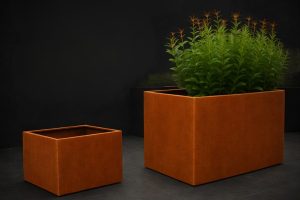
Metal Planter Installation Guide
Getting the installation right is as important as choosing the right metal planter. A well-specified planter on a badly prepared base or with inadequate drainage will produce poor plant performance regardless of the material quality. Follow these steps for the best results.
Step 1: Choose the position and check the surface
Place the planter in its final position before filling. A large metal planter becomes very difficult to move once planted. Check the position from several angles and confirm the spacing and alignment look right before committing.
For corten steel planters on light-coloured paving, check whether the planter is pre-weathered. If it is not, consider placing it on grass or gravel for six to eight weeks first to allow the heaviest phase of initial rust runoff to occur on a surface that can handle staining. Metal Planters Ltd pre-weathers all corten planters as standard, which significantly reduces this concern.
On roof terraces, planters should not sit directly on the waterproofing membrane. Use adjustable pedestals to raise the planter above the membrane surface and allow drainage to flow beneath it. For structural load confirmation on a flat roof or balcony, always consult a structural engineer before specifying large planted metal planters.
Step 2: Add drainage aggregate
Pour a 50 to 75mm layer of drainage aggregate into the base of the planter before adding any growing medium. Washed 10 to 20mm gravel is the standard choice. For weight-sensitive applications on roof terraces and balconies, use lightweight alternatives such as expanded clay balls (LECA) or perlite, which can provide equivalent drainage at 60 to 70 percent less weight per volume.
Confirm the pre-drilled drainage holes in the base of the planter are clear and unobstructed after the aggregate is in place.
Step 3: Lay geotextile membrane
Cut a piece of geotextile membrane to fit over the drainage aggregate layer. This prevents fine growing medium particles from washing into the aggregate over time and blocking the drainage holes. It is a simple step that makes a long-term difference to drainage efficiency.
Step 4: Add growing medium
Fill the planter with growing medium appropriate to the plants being grown. For standard ornamental planting, a 70/30 mix of multipurpose compost and horticultural grit works well. For trees and large shrubs, use a loam-based compost such as John Innes No. 3, which does not collapse and shrink over time the way peat-free multipurpose compost can.
For roof terrace and balcony applications, use a specialist lightweight container compost. These mixes typically weigh around 50 percent less than standard loam-based compost when saturated and are specifically formulated to retain nutrients and moisture while keeping dead weight to a minimum.
Step 5: Plant up and mulch
Remove the plant from its nursery container and gently tease out any tightly bound roots at the base of the root ball. Position the root ball so its top sits approximately 25 to 30mm below the rim of the planter. Backfill with growing medium and firm gently. Apply 30 to 50mm of decorative mulch over the surface to reduce moisture evaporation and give the planting a finished look.
Step 6: Water thoroughly and check drainage
Give the newly planted container a thorough first watering. Water should begin to drain from the base holes within one to two minutes. If drainage is slow, probe the drainage holes from below with a thin stick to confirm they are not blocked. After the first heavy rain, check the growing medium surface: it should not remain waterlogged more than a few hours after heavy rain.
| On roof terraces and balconies, always confirm the structural dead load capacity with a structural engineer before installing large planted metal planters. A 1000mm x 500mm x 600mm trough planter in 3mm steel, filled and planted, can weigh 150 to 200kg when the growing medium is saturated. Multiple planters add up quickly. Using 4mm aluminium planters with lightweight growing medium is the most effective way to reduce dead load while maintaining the planted result. |
| Maintenance note: powder-coated metal planters need no annual treatment. Wipe the exterior with a damp cloth and mild washing-up liquid once or twice a year. Check drainage holes in autumn to clear any leaf debris. For corten steel, no maintenance is required once the patina has established, typically within six to twelve months outdoors. |
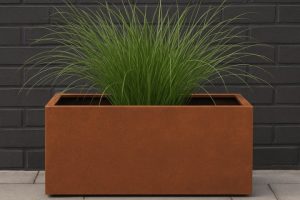
What to Plant in a Metal Planter
The right plant for a metal planter depends on the size and depth of the container, its position, and the aesthetic intent. Here are the plants that work most reliably in UK outdoor metal planters.
Best plants for a metal planter in the UK
- Ornamental grasses (Calamagrostis, Stipa, Festuca): The most consistently effective planting for both residential and commercial metal planters. The movement and texture of grasses complement the geometric hard lines of a metal planter perfectly. Calamagrostis ‘Karl Foerster’ is the most widely specified variety for trough planters.
- Box (Buxus sempervirens): Clipped box in a geometric form is a classic pairing for square metal planters, particularly in anthracite or galvanised steel. Year-round evergreen and tolerant of container conditions.
- Bay (Laurus nobilis): Standard bay trees in metal planters are a reliable and good-looking combination for entrances and courtyard gardens. Hardy and easy to clip into a formal shape.
- Phormium (New Zealand Flax): Bold and architectural. Bronze-foliage Phormiums sit visually within the same colour palette as corten steel, creating a coherent design combination.
- Lavender (Lavandula angustifolia): Drought-tolerant and fragrant. Works particularly well in sun-exposed positions and in trough planters with good drainage.
- Echinacea and Rudbeckia: Warm orange and yellow flowers that sit within the same colour palette as corten steel. Among the best choices for a naturalistic planting scheme in corten containers.
- Birch (Betula utilis jacquemontii): A single multi-stem birch in a large corten or steel cube planter is one of the most impactful planting combinations in contemporary residential landscape design. The white bark against the warm rust patina of corten is a combination landscape designers return to consistently.
- Bamboo (Fargesia murielae): Clumping bamboo for screening on terraces and balconies. Always use a clumping variety, not a running variety. Wind-tolerant and non-invasive.
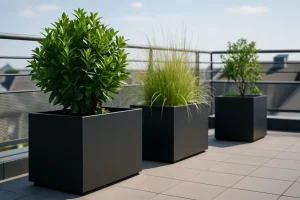
Metal Planter for Commercial and Industrial Settings
A metal planter in a commercial or industrial setting serves specific functions beyond aesthetics, and the specification decisions reflect that.
Hostile vehicle mitigation and security landscaping
Large format steel trough planters are increasingly used as hostile vehicle mitigation features in public realm applications. A 1500mm steel trough filled with growing medium and a planted specimen tree weighs several hundred kilograms and will stop a slow-moving vehicle. These planters can be designed to meet certified HVM standards while looking like considered landscape design rather than a security measure.
Brand coordination in commercial schemes
For hotels, corporate offices, and retail developments, the ability to specify a bespoke RAL colour and batch-coat all planters in a scheme ensures visual consistency across every unit. This matters because a slight colour difference between planters at a hotel entrance is the kind of detail that gets noticed and reflects poorly on the quality of the installation.
Metal Planters Ltd prepares detailed fabrication drawings for bespoke commercial planters. These can be reviewed and approved by the project architect or landscape architect before production begins, eliminating the risk of non-conforming deliveries on large projects.
Fire compliance on commercial buildings
On commercial buildings subject to the external fire requirements of Approved Document B, all materials in the external zone including metal planters need to be confirmed as non-combustible. Steel and aluminium planters achieve A2-s1,d0 classification under BS EN 13501-1 as standard, meeting this requirement without additional specification effort. See the UK government’s Approved Document B for the full regulatory context.
How Much Does a Metal Planter Cost in the UK?
Prices for metal planters in the UK vary depending on material, gauge, size, and finish. The table below gives indicative pricing for 2026 as a planning guide. Contact Metal Planters Ltd for a specific project quotation.
| Planter type / size | Material | Price range (inc. VAT) | Notes |
| Square cube 400x400x400mm | 3mm steel powder coat | £160 – £240 | Standard residential |
| Square cube 600x600x600mm | 3mm steel powder coat | £220 – £340 | Feature planter |
| Square cube 600x600x600mm | 4mm aluminium | £240 – £360 | Rooftop / balcony |
| Square cube 600x600x600mm | 3mm corten | £200 – £300 | Pre-weathered |
| Trough 1000x400x400mm | 3mm steel or corten | £260 – £380 | Border / divider |
| Trough 1500x500x500mm | 4mm aluminium | £420 – £600 | Lightweight large |
| Raised bed 1200x600x600mm | 3mm corten | £360 – £500 | Kitchen garden |
| Raised bed 1800x800x800mm | 3mm steel | £540 – £780 | Large raised bed |
| Bespoke (any size / shape) | Any metal | POA | Quoted within 24-48 hr |
To explore our full range, visit the Metal Planters Ltd homepage or go directly to our planters product page for sizes, materials, and an enquiry form. We are happy to discuss any project, from a single residential planter to a large commercial scheme.
Frequently Asked Questions About Metal Planters
| What is the best metal planter for outdoor use in the UK? |
| The best metal planter for outdoor use depends on where it is going. Aluminium is best for roof terraces and balconies where weight is a constraint, and for any application where zero maintenance is the priority. Corten steel is best when you want an evolving organic finish that improves with age. Mild or galvanised steel is best for commercial settings requiring impact resistance and good value. All three materials are genuinely weatherproof and far more durable than timber, terracotta, or plastic alternatives. |
| Do metal planters rust? |
| Aluminium metal planters do not rust. Aluminium forms a natural protective oxide layer and a scratch through the powder coat reveals more aluminium, not a surface that then corrodes. Corten steel metal planters develop a self-protecting stable rust patina over time, which is a deliberate property of the material and acts as a barrier against further corrosion. Mild steel planters rely on their powder coat or galvanised finish to prevent rust. If the coating is intact, they will not rust. |
| Are metal planters suitable for growing vegetables and food? |
| Yes. Metal planters including corten steel are safe for food growing. The trace elements released from weathering steel are within normal soil chemistry ranges and have no harmful effect on plants or on people consuming produce grown in them. Metal raised beds are widely used in domestic and commercial food production in the UK. |
| Can a metal planter be used on a roof terrace or balcony? |
| Yes. Aluminium metal planters are the preferred choice for roof terraces and balconies because they weigh significantly less than steel. Always confirm the dead load capacity of the roof slab or balcony with a structural engineer before installing large planted planters. Metal planters must not be placed directly on a flat roof waterproofing membrane: use adjustable pedestals. Steel and aluminium planters both meet the A2-s1,d0 non-combustible fire classification required on high-rise buildings. |
| How do I prevent a corten metal planter from staining my paving? |
| During the initial weathering period of three to nine months, corten steel produces rust-coloured water runoff that can stain pale or porous paving. The most effective precautions are: use pre-weathered corten (Metal Planters Ltd supplies all corten planters pre-weathered as standard); raise the planter on feet for clearance; place a 50 to 75mm border of dark gravel around the planter base; and use a temporary drip tray on sensitive surfaces during the first few months. Once the patina has stabilised, runoff reduces to negligible levels. |
| How long does a metal planter last? |
| An aluminium metal planter with an external-grade powder coat should last 30 or more years without replacement. A corten steel planter should last 40 or more years through the self-healing mechanism of its patina. A quality mild steel powder-coated planter will typically last 20 to 30 years outdoors with an intact coating. Metal planters significantly outlast timber, terracotta, and plastic containers in outdoor UK conditions. |
| What sizes of metal planter are available from Metal Planters Ltd? |
| Standard sizes range from compact 300mm to 400mm cubes through to large commercial trough planters over 2m long and raised beds up to 1800mm and beyond. Bespoke sizes are our most common order type and carry no significant price premium. Provide us with your dimensions and preferred material and we will quote within 24 to 48 hours. |
| What are the fire regulations for metal planters on a balcony? |
| On residential buildings above 18m in England, all external materials including planters must meet A2-s1,d0 or A1 classification under BS EN 13501-1. Both aluminium and steel meet A2-s1,d0 as standard without any additional treatment or certification. Timber, plastic, and fibreglass planters do not meet this classification and should not be specified on high-rise balconies and terraces. Always confirm with the building’s fire engineer or building control officer for specific project compliance. |
Conclusion
A metal planter is one of the most durable, versatile, and low-maintenance choices available for any outdoor planting application in the UK. Whether you need a single residential planter for a patio, a complete terrace system for a high-rise development, or a bespoke commercial scheme coordinated with an architectural colour palette, there is a metal planter specification that fits the brief.
The key decisions are straightforward once you understand the options. Aluminium where weight is a concern. Corten steel where an evolving organic aesthetic is the goal. Mild or galvanised steel where impact resistance and cost-effectiveness matter most. Any of the three for buildings where non-combustible materials are required by regulation.
Metal Planters Ltd fabricates all three materials from our workshop in Chelmsford, Essex, with bespoke sizing as standard and no tooling costs for non-standard dimensions. We supply residential customers, landscape architects, developers, and commercial contractors across the UK, and we are happy to discuss any project large or small.
Visit the Metal Planters Ltd homepage to explore our full range, or go directly to the planters product page to browse our steel, aluminium, and corten options. Call us on 01245 922332 or email sales@metal-planters.co.uk to discuss your project.