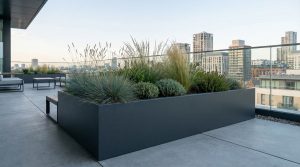
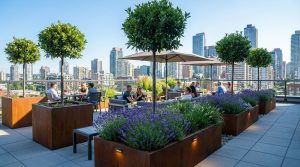
A well-chosen metal planter is often the single element that makes a terrace look genuinely designed rather than just furnished. You can have the best decking, the right furniture, and even good lighting, and the terrace still looks like it is missing something. Add a row of large corten steel planters along the boundary edge, or a pair of powder-coated steel cubes flanking the door, and the space suddenly reads as considered and complete.
Terraces in the UK have changed a lot in the past decade. What used to be a paved area with a bistro set and a couple of plastic pots has become, in many homes and commercial buildings, a genuinely designed outdoor room. Architects specify them. Landscape designers plan them. Developers build them into high-rise residential schemes as a significant amenity feature. And in all of these settings, the metal planter has become one of the most consistently specified and most reliable elements in the design.
At Metal Planters Ltd in Chelmsford, Essex, we design and fabricate metal planters for residential terraces, rooftop amenity spaces, commercial hospitality settings, and public realm installations. We supply landscape architects, developers, contractors, and homeowners across the UK. This guide covers everything you need to know about specifying, installing, and planting a metal planter on a terrace in 2026.
What Is a Metal Planter?
A metal planter is a container fabricated from sheet metal, used to grow plants in outdoor or indoor settings. Unlike moulded containers such as terracotta, fibreglass, or plastic, a metal planter is cut, folded, and welded from flat sheet material. This means it can be made to virtually any size or shape without tooling costs.
The most common metals used for planters in the UK are mild steel, aluminium, and corten weathering steel. Each has a different finish, weight, and performance characteristic. The right choice depends on where the planter is going, what it needs to look like, what load constraints apply (particularly relevant on roof terraces), and how much maintenance the owner wants to do in the long run.
Metal planters have become the dominant container type in contemporary landscape design for both residential and commercial terraces. They are maintenance-free in normal outdoor use, they are available in bespoke sizes without premium, and the clean geometric forms suit the architectural aesthetic of most modern UK buildings.
Metal planters vs other terrace container options
Terracotta cracks in frost. Timber rots without annual treatment. Fibreglass can look good initially but tends to show UV degradation and surface crazing after several years in a UK outdoor environment. Concrete is heavy and awkward to specify in bespoke sizes. Metal planters, by comparison, do not rot, do not crack in frost, do not fade noticeably for twenty or more years, and can be fabricated to any dimension.
For roof terraces specifically, the weight advantage of aluminium over concrete or stone is often decisive. A structural engineer calculating dead load capacity for a flat roof slab will quickly confirm that a 4mm aluminium planter filled with lightweight growing medium can be specified where a concrete or stone equivalent would exceed the load budget.
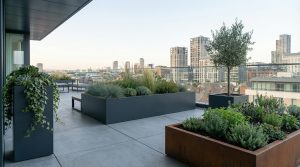
Types of Metal Planter for Your Terrace
The shape and format of a metal planter matters as much as the material choice. Here is a breakdown of the main types and what each one does best on a terrace.
Square and cube metal planters
Square planters are the most versatile terrace planter form. They work in pairs to frame an entrance or doorway, as individual statement pieces on a paved terrace, or in rows along a boundary or balustrade. A cube planter, where height and width are roughly equal, reads as bold and deliberate. It creates a sense of permanence that lower containers do not.
For residential terraces, a 400 to 600mm square planter is the most common size. For commercial and rooftop terrace schemes, sizes from 700 to 1000mm square and above are standard. A single corten steel cube planted with a clipped box ball or a standard bay tree is one of the most consistently effective planter compositions for a contemporary UK terrace.
Rectangular trough metal planters
Trough planters are the workhorse of terrace design. The long horizontal form creates a continuous planted line that reads as a designed feature rather than a collection of individual pots. For terrace boundaries, trough planters define the edge while contributing greenery that softens the hard surfaces.
Long trough planters also have a practical advantage on exposed terraces: they present a lower wind profile than tall individual containers, which reduces overturning forces on the supporting surface. Standard trough lengths run from 800mm to 2000mm. Modular systems allow seamless runs at any length for large commercial terrace projects.
Raised bed metal planters
Raised beds are increasingly popular on residential terraces, particularly for kitchen herb gardens and food growing. A metal raised bed at 600 to 800mm height makes planting and harvesting genuinely comfortable. Metal raised beds drain better than ground-level beds, warm up faster in spring, and create a clean edge that is easy to maintain.
Corten steel raised beds on a terrace look particularly good against the warm tones of brick, render, and timber decking. The earthy rust patina sits naturally alongside planted foliage in a way that grey metal or white powder coat does not always manage.
Tall column and statement planters
Tall column planters create vertical drama on a terrace that shorter containers simply cannot provide. A pair of 1000mm tall column planters planted with single-stem ornamental grasses flanking a terrace entrance creates an architectural moment that frames the space and draws the eye.
The practical consideration is stability. Tall planters in exposed positions, particularly on roof terraces, need ballasting in the lower section or fixing to the surface to prevent overturning in high winds. Metal Planters Ltd can advise on fixing and ballasting strategy for tall planters on a project-specific basis.
Wall-mounted metal planters
Wall-mounted planters are ideal for compact terraces where floor space is at a premium. Aluminium wall-mounted planters are light enough to be fixed to most masonry walls with standard fixings. They are popular for herb growing and for adding a planted vertical element to rendered walls and fences.
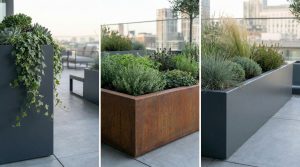
Aluminium vs Steel vs Corten Metal Planter
The three main metals used for terrace planters in the UK are mild steel (including galvanised), aluminium, and corten steel. The differences between them are significant enough to affect the design outcome, the practical performance, and the long-term cost of your terrace.
| Factor | Aluminium | Steel (powder coat) | Corten Steel |
| Aesthetic | Modern, any RAL colour | Industrial, any RAL colour | Warm organic rust patina, living finish |
| Weight | Lightest – approx 11 kg/m2 at 4mm | Heavy – approx 23 kg/m2 at 3mm | Heavy – approx 23 kg/m2 at 3mm |
| Rust resistance | Excellent – natural oxide layer | Relies on coating integrity | Self-protective stable patina |
| Maintenance | None | None if coating intact | None once patina established |
| Fire classification | A2-s1,d0 (non-combustible) | A2-s1,d0 | A2-s1,d0 |
| Staining risk | None | None | During initial weathering only |
| Best for terraces | Rooftop, balcony, load-sensitive sites | Ground level, commercial impact | Residential, naturalistic design schemes |
| Lifespan | 30+ years | 20-30 years with intact coating | 40+ years |
| Colour options | Any RAL powder coat | Any RAL powder coat | Natural rust patina only |
| Bespoke sizing | Yes | Yes | Yes |
Aluminium metal planter on a terrace
Aluminium is the best choice for roof terraces and any application where structural dead load is a limiting factor. It weighs roughly one third as much as steel for an equivalent gauge, which matters considerably when a structural engineer has set a maximum load per square metre for a flat roof slab.
Aluminium does not rust. A scratch through the powder coat reveals more aluminium, not a surface that will then corrode. The finish stays consistent for decades with no annual treatment. Our 4mm aluminium planters provide excellent rigidity for large commercial terrace formats while keeping dead weight as low as possible.
Steel metal planter on a terrace
A steel metal planter offers the best combination of cost-effectiveness and structural robustness. At 3mm gauge, a steel planter is an extremely solid, rigid object that can absorb impacts from vehicles and maintenance equipment. For ground-level commercial terraces, hospitality forecourts, and public realm spaces where impact resistance matters, steel is the right specification.
The powder-coat finish on a quality steel planter will last twenty or more years without fading. Any RAL colour is achievable, and batch-coating all the planters in a scheme together ensures visual consistency across every unit.
Corten metal planter on a terrace
A corten metal planter offers an aesthetic that no other material can replicate. The warm bronze and copper tones of the weathering patina develop gradually over six to twelve months outdoors and deepen and settle over the years. For naturalistic garden design schemes, for residential terraces where the planting is soft and organic, and for any project where a living, evolving finish is part of the design intent, corten is the most compelling choice.
Metal Planters Ltd supplies all corten planters pre-weathered as standard. This means the heaviest phase of initial rust runoff has already occurred before delivery, which significantly reduces the staining risk on terrace paving from day one.
| For a roof terrace where weight is critical, always choose aluminium. For a residential ground-level terrace where the aesthetic is naturalistic or contemporary, corten is hard to better. For a commercial terrace where impact resistance and colour consistency matter most, specify steel. All three materials meet the A2-s1,d0 non-combustible fire classification required for high-rise buildings under BS EN 13501-1. |
Where to Use a Metal Planter on a Terrace
Understanding where a metal planter works best on a terrace is as important as choosing the right material and shape. Placement affects stability, plant performance, visual composition, and in some cases the structural loading on the terrace surface.
Terrace boundary and perimeter edges
Placing a row of trough planters along the boundary edge of a terrace is one of the most effective design moves available. It creates a soft planted edge that visually separates the terrace from the surrounding area, provides privacy screening if planted with taller specimens, and defines the usable space without requiring a permanent fence or balustrade.
On roof terraces, long low trough planters along the perimeter also contribute to wind protection for the planted and sitting areas inside. A row of corten or aluminium troughs planted with tall ornamental grasses creates a filtered wind barrier that is far more effective than a solid screen and considerably more attractive.
Flanking doorways and terrace entrances
A pair of matching metal planters either side of a door or gate onto a terrace creates an arrival moment. It marks the threshold, frames the view into the space, and immediately signals that the terrace is designed rather than assembled. This is one of the most consistently effective and cost-efficient ways to use metal planters on a residential terrace.
For this application, cube planters in sizes between 400mm and 600mm square work well for standard residential doorways. Larger 700 to 800mm cubes are more appropriate for commercial or architecturally significant entrances. Corten steel with a standard bay tree or a box ball is a classic combination. Anthracite aluminium with ornamental grass is equally strong.
Zone definition on larger terraces
On larger terraces, metal planters can be used to divide the space into distinct zones: a dining area, a seating area, a planted garden area. This is particularly valuable on commercial hospitality terraces and on large residential roof terraces where a single open space can feel featureless and difficult to use.
Trough planters placed at right angles to each other create soft room dividers that define the zones without closing them off visually. Planting that carries scent, particularly lavender, rosemary, and herbs in kitchen terrace settings, makes the zones feel genuinely distinct even in a relatively compact space.
Balconies and compact urban terraces
For balconies in apartment buildings, aluminium is the clear material choice. It is the lightest option, which matters when balcony slabs often have tighter load limits than ground-level terraces. The RHS recommends non-porous materials such as metal for container planting on balconies and roof gardens, as they retain moisture better than terracotta and are more suitable for the more exposed conditions typical of these elevated sites.
Wall-mounted aluminium planters remove weight from the floor slab entirely and are an excellent choice for very compact balconies where every square metre of floor space is valuable.
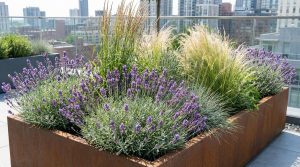
Benefits of a Metal Planter on a Terrace
There are specific, practical reasons why metal planters are the most consistently specified container type for UK terraces in 2026. Here is an honest summary.
- Maintenance-free in normal outdoor use: Powder-coated metal planters need no annual treatment, painting, or sealing. A wipe-down with a damp cloth once or twice a year keeps them looking sharp.
- Any size, any shape without tooling costs: Metal planters are fabricated rather than moulded. Any dimension is achievable without the mould setup costs that apply to fibreglass or concrete. Bespoke sizing at Metal Planters Ltd is our most common order type and carries no significant premium.
- Consistent colour across an entire scheme: Batch powder-coating ensures every planter in a scheme is in exactly the same colour. This is not achievable with timber, terracotta, or stone planters at reasonable cost.
- Fire compliant for high-rise terraces: Aluminium and steel achieve A2-s1,d0 classification under BS EN 13501-1. This non-combustible classification is required for external materials on residential buildings above 18m under Approved Document B. Timber, plastic, and fibreglass do not meet this classification.
- Lightweight options for load-sensitive sites: 4mm aluminium planters weigh roughly half as much as equivalent 3mm steel planters. For roof terraces where structural dead load is a limiting factor, this can make the difference between a planting scheme being structurally feasible or not.
- Long service life: A quality powder-coated aluminium terrace planter should last 30 or more years. Corten steel will last 40 or more years. The long-term cost per year of use compares very well against timber or fibreglass alternatives that need repainting or replacement within ten to fifteen years.
- Strong and inherently stable: A steel trough planter filled with growing medium and a planted specimen is a substantial, stable object. It is not going to blow over in a British gale or be easily displaced in a public space.
- Designed aesthetic that improves the kerb appeal of any property: A well-specified metal planter on a terrace elevates the visual quality of the outdoor space in a way that plastic, resin, or low-quality timber containers simply cannot match.
How to Design Your Terrace with Metal Planters
There are a few practical design principles worth understanding before you order. Getting these right means the planters look deliberate and considered when they arrive. Getting them wrong means you end up with a collection of pots that do not read as a coherent scheme.
Use fewer, larger planters rather than many small ones
The single most common mistake on residential terraces is buying too many small planters in too many different shapes and materials. Two large 600mm corten steel cubes will always look better than eight 300mm terracotta pots in a variety of finishes. The larger planter reads as a design decision. The collection of small pots reads as accumulated afterthought.
If the budget does not stretch to very large planters, two or three medium-sized planters of the same shape and material still looks considerably more coherent than a mixed collection of similar cost.
Match the material to the architectural palette
Corten steel suits warm palettes: brick, timber, stone, render in warm tones. Its rust-coloured patina sits naturally in these settings. Anthracite or black powder-coated steel suits darker, more contemporary palettes: charcoal render, dark brick, dark timber cladding, and dark window frames. White or light grey aluminium suits pale rendered buildings and Scandinavian-influenced architectural styles.
The goal is that the planter looks like it belongs to the building rather than having been bought separately. Matching the planter colour to an existing architectural element (window frame colour, coping colour, or balustrade colour) is a straightforward way to achieve this.
Consider the planting height in relation to the terrace space
The height of the planted composition matters as much as the planter itself. A 600mm planter planted with an ornamental grass that reaches 1500mm creates a vertical element of about 2100mm in total. On a terrace with a 2400mm clear height to the soffit or balcony above, this reads as comfortable and appropriately scaled. On a lower terrace, the same combination could feel cramped.
Think about the planted height as part of the composition from the beginning. Shorter, ground-hugging plants in tall cube planters look odd: the planter dominates the planting. Taller specimens in shorter, wider troughs can look unstable visually even when they are perfectly stable structurally. The planted height and the planter proportion should feel balanced.
Metal Planter Installation Guide
Installing a metal planter correctly is as important as specifying the right one. Poor drainage setup produces poor plant performance regardless of the planter material. Follow these steps for the best results on a terrace.
Step 1: Plan the position before you fill anything
A large metal planter filled with growing medium is very heavy and very difficult to move. Plan the positions carefully before delivery arrives. Walk the terrace and check sightlines from every angle: from the door looking out, from the seating area looking across, and from outside looking in. Mark the positions with tape or chalk before the planters arrive.
On a roof terrace, always have a structural engineer confirm the dead load capacity before specifying large planted containers. A 1000mm x 500mm x 600mm trough planter in 3mm steel, filled and planted, can weigh 150 to 200kg when the growing medium is saturated. Multiple large planters add up quickly.
Step 2: Raise the planter on feet or pedestals
All Metal Planters Ltd planters come with raised feet as standard, which give 15 to 20mm of clearance from the surface. This clearance allows drainage to exit freely from the base holes, prevents rust-coloured water from sitting in contact with the paving (important for corten steel planters), and allows air circulation under the base.
On flat roof terraces, planters should not sit directly on the waterproofing membrane. Use adjustable pedestals to raise the planter above the membrane surface. This protects the membrane from point loading, maintains the designed drainage fall of the roof beneath the planter, and prevents moisture from being trapped between the planter base and the membrane.
Step 3: Build the drainage layer
Before adding any growing medium, place a 50 to 75mm layer of drainage aggregate at the base of the planter. Standard washed 10 to 20mm gravel works well. For weight-sensitive roof terrace applications, use expanded clay balls (LECA) or perlite, which provide equivalent drainage at 60 to 70 percent less weight per volume.
Place a layer of geotextile weed membrane over the drainage aggregate. This prevents fine growing medium particles from washing down into the aggregate over time and blocking the drainage holes. It is a simple step that makes a significant long-term difference to drainage efficiency.
Step 4: Choose the right growing medium
For standard ornamental terrace planting, a 70/30 mix of multipurpose compost and horticultural grit drains well and provides adequate nutrition. For trees and large shrubs, use a loam-based compost such as John Innes No. 3, which does not collapse and compact over time the way peat-free multipurpose compost can.
For roof terrace and balcony applications, use a specialist lightweight container compost. These mixes typically weigh around 50 percent less than standard loam-based compost when saturated and are specifically formulated to retain nutrients and moisture while keeping dead weight to a minimum.
Step 5: Plant up and mulch
Remove the plant from its nursery container and gently tease out any tightly bound roots at the base of the root ball. Tightly circling roots that are not loosened before planting will continue to grow in the same circular pattern rather than spreading into the new growing medium.
Position the root ball so its top sits approximately 25 to 30mm below the rim of the planter. This leaves room for watering without overflow. Backfill with growing medium and firm gently. Apply 30 to 50mm of decorative mulch (bark, slate chippings, or gravel) over the surface to reduce moisture evaporation and give the planting a finished look.
Step 6: Water thoroughly and check drainage
Give the newly planted container a thorough first watering. Water should begin to drain from the base holes within one to two minutes of a generous application. If drainage is slow, probe the drainage holes from below with a thin stick to confirm they are not blocked. After the first significant rain event, check the growing medium surface: it should not remain visibly waterlogged more than a few hours after heavy rain.
| On roof terraces and balconies, always confirm the structural dead load capacity with a structural engineer before installing large planted metal planters. Using aluminium planters with specialist lightweight growing medium is the most effective way to reduce dead load while maintaining the planted result. |
What to Plant in a Metal Planter on a Terrace
The right planting makes the difference between a terrace that looks good in photographs and one that looks good every day of the year. Here are the plants that work most reliably in metal planters on UK terraces.
Year-round structure and interest
- Calamagrostis ‘Karl Foerster’: The most consistently effective planting for metal trough planters on terraces. Upright, architectural, and reliably perennial. Moves beautifully in wind. Holds its form through winter.
- Box (Buxus sempervirens) clipped: Classic formal planting for square and cube planters. Year-round evergreen structure. Works particularly well in anthracite or galvanised steel planters.
- Phormium: Bold and architectural. Bronze-foliage varieties sit within the same colour palette as corten steel. Evergreen and very tolerant of container conditions.
- Lavender: Drought-tolerant, fragrant, and very well-suited to well-drained terrace planter conditions. Works best in south-facing or full-sun positions.
Screening and privacy planting
- Fargesia murielae (clumping bamboo): The best privacy screening plant for tall trough planters on terraces and balconies. Wind-tolerant, non-invasive, and fast-growing. Provides year-round screening.
- Stipa gigantea: Tall ornamental grass with airy golden flowerheads in summer. Creates a semi-transparent screen that filters wind without blocking it completely.
- Tall evergreen shrubs (Pittosporum, Viburnum tinus): For denser year-round screening in large trough planters on sheltered terraces.
Seasonal colour
- Echinacea and Rudbeckia: Warm amber, orange, and yellow flowers that sit within the same colour palette as corten steel. Long-flowering summer perennials.
- Agapanthus: Striking blue or white summer flowers. Evergreen strap leaves year-round. Does particularly well in constrained root conditions, making container growing quite effective.
- Seasonal bedding: For planters near a main entrance or seating area, seasonal bedding in spring and summer fills in gaps between permanent plantings and adds reliable seasonal colour.
Metal Planter for Commercial Terraces
Commercial terrace projects have different requirements from residential ones. The planter specification needs to work within a building’s fire compliance framework, the planters themselves need to be robust enough to withstand general public interaction, and the visual specification needs to coordinate with the building’s architectural palette.
Hotel and hospitality terraces
Hotel and restaurant terraces are typically specified to a very high standard because the planters form part of the guest experience. For these settings, Metal Planters Ltd works with the project architect or landscape architect to produce detailed fabrication drawings for each planter, batch-coat all units in the same production run for colour consistency, and deliver to a programme that fits the wider project schedule.
For hospitality terraces, large steel trough planters planted with trained specimens (standard lollipop Photinia, trained bay, or standard olive) are the most commonly specified combination. These planters can also be designed to serve as physical barriers around the perimeter of an outdoor dining area.
Office and corporate terraces
Corporate office terraces are increasingly specified as genuine amenity spaces for employees, particularly since the shift in working patterns post-2020. The planting specification for these spaces tends to focus on low-maintenance, year-round interest: evergreen grasses, clipped structural shrubs, and seasonal colour.
Metal Planters Ltd also supplies complete roof terrace systems for commercial office buildings, integrating the planter specification with the structural subframe, pedestal system, decking, and drainage strategy. Explore our terrace systems and supports for the full picture of what a coordinated terrace specification from Metal Planters Ltd involves.
Fire compliance on commercial terraces
On commercial buildings and residential buildings above 18m, all external materials including metal planters must meet A2-s1,d0 or A1 classification under BS EN 13501-1. Both aluminium and steel meet A2-s1,d0 as standard, making them fully compliant for use in regulated external zones. Our metal planter range page has full material and specification details for compliance purposes.
How Much Does a Metal Planter Cost in 2026?
Prices for metal terrace planters in the UK vary depending on material, gauge, size, and finish. The table below gives indicative pricing for 2026 as a planning guide. Contact Metal Planters Ltd for a project-specific quotation.
| Planter type / approximate size | Material | Price range (inc. VAT) | Notes |
| Square cube 400x400x400mm | 3mm steel powder coat | £160 – £240 | Residential entrance |
| Square cube 600x600x600mm | 3mm corten | £200 – £300 | Pre-weathered finish |
| Square cube 600x600x600mm | 4mm aluminium | £240 – £360 | Roof terrace spec |
| Trough 1000x400x400mm | 3mm steel or corten | £260 – £380 | Boundary / zone divider |
| Trough 1500x500x500mm | 4mm aluminium | £420 – £600 | Light weight large trough |
| Raised bed 1200x600x600mm | 3mm corten | £360 – £500 | Terrace kitchen garden |
| Raised bed 1800x800x800mm | 3mm steel | £540 – £780 | Large raised bed |
| Tall column 250x250x1000mm | 3mm steel or corten | £220 – £360 | Vertical accent |
| Bespoke (any size and shape) | Any material | POA | Quote within 24-48 hrs |
Browse the full range at the Metal Planters Ltd homepage or go directly to our planters product page to see all materials, sizes, and specification details. Contact us on 01245 922332 or at sales@metal-planters.co.uk to discuss your terrace project.
Frequently Asked Questions About Metal Planters for Terraces
| What is the best metal planter for a roof terrace? |
| Aluminium is the best choice for a roof terrace in most cases. It weighs roughly one third as much as equivalent steel planters, which matters considerably when the structural engineer has set a maximum dead load for the roof slab. 4mm aluminium planters provide excellent rigidity for large terrace formats while keeping weight to a minimum. Both aluminium and steel meet the A2-s1,d0 non-combustible fire classification required for high-rise terraces. |
| How do I stop a corten steel planter from staining my terrace paving? |
| During the initial weathering period, corten steel produces rust-coloured water runoff that can stain pale porous paving. Metal Planters Ltd supplies all corten planters pre-weathered, which means the heaviest phase of initial runoff has already occurred before delivery. Using planter feet for clearance, a small gravel border around the base, and a temporary drip tray during the first few months are all effective precautions. Once the patina has fully stabilised, ongoing runoff reduces to negligible levels. |
| How much does a metal planter weigh on a terrace? |
| The planter itself is only part of the total weight. The main load comes from the growing medium and plants. A 1000mm x 500mm x 600mm steel trough planter filled with growing medium and a planted specimen typically weighs 150 to 200kg when the growing medium is saturated. Aluminium planters with lightweight container compost can reduce this by 30 to 50 percent. Always confirm structural dead load capacity with a structural engineer before installing large planted containers on a roof terrace or balcony. |
| Can I use a metal planter indoors as well as on a terrace? |
| Yes. Powder-coated aluminium and steel planters are suitable for indoor use with no modifications. Corten steel can be used indoors with a watertight inner liner to prevent rust runoff from contacting interior flooring. For a genuinely clean indoor application, powder-coated aluminium or steel with a removable inner pot is the more straightforward choice. |
| How long will a metal planter last on a terrace? |
| An aluminium terrace planter with a quality external-grade powder coat should last 30 or more years. Corten steel will last 40 or more years. A well-specified mild steel powder-coated planter will typically last 20 to 30 years with an intact coating. Metal planters significantly outlast timber, terracotta, and plastic alternatives in the outdoor UK conditions typical of a terrace. |
| What sizes of metal planter are available? |
| Standard sizes at Metal Planters Ltd range from compact 300mm cubes to large commercial trough planters over 2m long and raised beds up to 1800mm. Bespoke sizes are our most common order type and carry no significant price premium. Provide your dimensions and preferred material and we will produce a quote within 24 to 48 hours. |
| Does a metal planter need drainage holes? |
| Yes, for all standard planting applications. Metal Planters Ltd supplies all planters with drainage holes pre-drilled in the base as standard. Without drainage holes, water accumulates at the root zone and causes root rot. If you need a planter without drainage holes for a specific installation (a water feature insert or a surface where drainage is not possible), please specify this at the time of ordering. |
| Can metal planters be used on a balcony above 18m? |
| Yes. Both aluminium and steel planters meet the A2-s1,d0 non-combustible fire classification under BS EN 13501-1, which is required for external materials on residential buildings above 18m under Approved Document B. Timber, plastic, and fibreglass planters do not meet this classification and should not be specified on high-rise balconies. |
Conclusion
A well-specified metal planter transforms a terrace from an outdoor floor into a genuinely designed outdoor room. Whether you are planning a residential terrace in a suburban garden, a rooftop amenity space on a new-build development, or a commercial hospitality terrace for a hotel or restaurant, the right metal planter brings structure, permanence, and visual quality that no other container material can match at comparable cost and lifespan.
The key decisions are straightforward once you understand them. Aluminium for roof terraces and weight-sensitive sites. Corten steel for naturalistic and residential schemes where an evolving organic finish suits the setting. Steel for commercial impact, value, and any colour. All three are maintenance-free in normal outdoor use. All three meet non-combustible fire classification requirements for regulated buildings. All three are available in bespoke sizes without tooling costs.
Metal Planters Ltd fabricates all three materials at our workshop in Chelmsford, Essex. We supply residential customers, landscape architects, developers, and commercial contractors across the UK. We are happy to discuss any project, from a single terrace planter pair to a large commercial scheme.
Visit the Metal Planters Ltd homepage to explore the full range, or go directly to the planters product page to browse steel, aluminium, and corten options. Call us on 01245 922332 or email sales@metal-planters.co.uk to discuss your terrace project.