
Finding the right metal planter for a roof terrace is a different challenge from buying a planter for a garden. The decisions you make about material, weight, size, and drainage have real structural and compliance consequences. And there are more wrong answers than right ones if you rush in without understanding what the project actually needs. If you are planning roof terrace planters UK style, whether for a residential rooftop extension, a commercial amenity space, or a high-rise balcony, this guide is written specifically for you.
At Metal Planters Ltd in Chelmsford, Essex, we design and fabricate metal planters for residential terraces, rooftop amenity spaces, commercial developments, and public realm installations across the UK. We have worked on rooftop planting schemes from a single residential flat-roof extension to multi-unit commercial terrace projects on buildings above 18m. This guide brings together everything we know about the subject.
We will cover materials, structural dead load, fire compliance, installation sequence, plant selection, and what the job should cost in 2026. By the end of it you will have a clear picture of what the right metal planter for your roof terrace looks like.
What Is a Metal Planter?
A metal planter is a container made from fabricated sheet metal, used to grow plants outdoors or indoors. It is produced by cutting, folding, and welding flat sheet material rather than moulding or casting, which means almost any size or shape is achievable without mould costs or tooling charges.
The three main metals used for planters in the UK are mild steel, aluminium, and corten weathering steel. Each behaves differently in terms of weight, corrosion resistance, maintenance requirement, fire classification, and surface finish. For a roof terrace application, these differences matter more than in any other planting context, because the structural load constraints of a flat roof slab make the material choice a structural engineering decision as much as a design one.
Metal planters on rooftops versus ground-level gardens
At ground level, the choice between a metal planter and a terracotta, timber, or fibreglass alternative is primarily about aesthetics, lifespan, and maintenance. Metal wins on most of those criteria, but the wrong choice does not have structural consequences.
On a rooftop, every kilogram of planter, growing medium, and plant sits on a finite load budget determined by the structural capacity of the roof slab. A poorly specified heavy planter can push the total dead load beyond what the structure can carry. A planter placed directly on a flat roof membrane can create point loads that damage the waterproofing. Getting the material right is not just about preference. It is part of the structural specification.
This is why lightweight aluminium planters and specialist lightweight growing medium are so consistently specified for UK roof terrace projects. Not because aluminium is the only valid material, but because on a weight-constrained rooftop, it usually gives the most planting for the available load budget.
Types of Metal Planter for Roof Terraces
Several distinct metal planter formats are used on UK roof terraces, and the right choice depends on the design intent, the available structural load budget, and whether the planters sit on the surface or are integrated into the terrace subframe system.
Rectangular trough planters
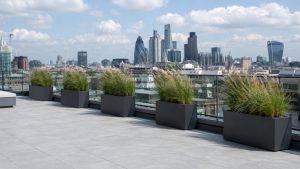
Trough planters are the most widely specified format for roof terrace boundary planting. Long, low, and practical, they create a continuous planted edge that provides privacy, softens the hard line of a parapet or balustrade, and defines the outer boundary of the usable space. They present a lower wind profile than tall individual containers, which reduces overturning risk in the exposed conditions typical of elevated terraces. Standard lengths run from 800mm to 2000mm; modular systems allow seamless longer runs.
Square and cube planters
Square planters work well as focal points on a roof terrace, in pairs flanking an access point or as symmetrical accent pieces near a seating area. In aluminium at 500 to 700mm square and 500 to 600mm tall, they are the right scale for most residential rooftop spaces. Their compact footprint distributes load efficiently and they are easy to position within a pedestal-supported terrace subframe grid.
In-deck integrated planters
For higher-specification projects, planters can be designed to sit within an opening in the terrace subframe so that the planter rim is flush with the finished terrace surface. This in-deck detail creates a seamless planted surface that reads as architecturally considered rather than as a series of containers sitting on top of a deck. It requires the planter dimensions to be co-ordinated with the subframe layout from the beginning of the design process.
Raised bed planters
Metal raised beds at 600 to 800mm height on a roof terrace create an ergonomically comfortable growing space and a bold architectural element. For food growing on a residential rooftop or as a feature planting element on a commercial amenity terrace, raised beds in 4mm aluminium with a lightweight growing medium specification are a practical and visually striking choice.
Tall column planters
Tall column planters add vertical drama to a rooftop terrace and are effective as architectural accent pieces near entrances or corners of seating areas. In exposed rooftop positions, they need to be ballasted in the lower section or mechanically fixed to the terrace surface to prevent overturning in high winds. Metal Planters Ltd advises on fixing and ballasting for tall planters on a project-by-project basis.
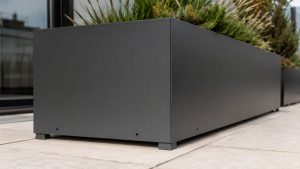
Aluminium vs Steel vs Corten Metal Planter: Roof Terrace Comparison
The material decision is the most important specification choice for a roof terrace planter. For rooftop applications, the differences in weight, fire classification, and long-term performance make the choice genuinely consequential in a way that matters beyond aesthetics.
| Factor | Aluminium | Powder-coat Steel | Corten Steel |
| Weight at standard gauge | ~11 kg/m2 at 4mm (lightest) | ~23 kg/m2 at 3mm | ~23 kg/m2 at 3mm |
| Roof dead load impact | Best – lowest dead load | Higher – check engineer | Higher – check engineer |
| Fire classification | A2-s1,d0 non-combustible | A2-s1,d0 | A2-s1,d0 |
| Rust risk | None – natural oxide layer | Good with intact coating | Self-protective stable patina |
| Staining risk on paving | None | None | Pre-weathered: minimal risk |
| Maintenance | None | None if coating intact | None once patina established |
| Colour options | Any RAL powder coat | Any RAL powder coat | Natural rust patina only |
| High-rise suitability | Excellent (A2 compliant) | Yes (A2 compliant) | Yes (A2 compliant) |
| Bespoke sizing | Yes – cost-effective | Yes | Yes |
| Best suited to | All rooftop use, especially above 18m | Low-rise or ground-level | Residential design-led schemes |
Why aluminium is the preferred metal planter material for rooftops
A 4mm aluminium planter body weighs approximately 11 kg per square metre of surface area. The equivalent 3mm steel or corten planter weighs approximately 23 kg per square metre. Before any growing medium or planting is added, the steel planter has already used roughly double the structural dead load budget.
On a residential flat roof extension with a typical 1.5 kN per square metre imposed dead load allowance, the difference between specifying aluminium and steel for ten planters can be over 100 kg of dead load. That is not a small number in structural engineering terms. Specifying aluminium planters with specialist lightweight container compost can make a planting scheme feasible that would exceed the structural limit with steel and standard topsoil.
Metal Planters Ltd fabricates all aluminium planters from 6082-T6 structural aluminium alloy, powder-coated in any RAL colour, with a 20-year external-grade coating warranty.
Corten steel on a roof terrace
Corten is specified for roof terraces where the warm, evolving rust patina is a core part of the design brief. The organic character of weathering steel looks particularly effective paired with soft naturalistic planting on a residential rooftop where the design aesthetic runs toward earthy, natural tones.
Metal Planters Ltd supplies all corten planters pre-weathered. This means the initial heavy rust runoff phase has already happened before delivery, which significantly reduces the staining risk to the terrace surface and the roof drainage system from day one.
| For most rooftop terrace projects, the practical choice is aluminium for the primary planting scheme and corten or steel only where the structural dead load budget genuinely allows it and the design intent specifically calls for that material. If you are not sure, the structural engineer’s dead load calculation will tell you exactly what headroom you have. |
Roof Terrace Weight and Structural Load: What You Need to Know
Weight is the single most important practical consideration for any roof terrace planter specification. Structural engineers design flat roof slabs to carry a specified imposed dead load measured in kilonewtons per square metre. Every component of the terrace system, including the planter bodies, growing medium, plants, water retained after rain, surface finishes, furniture, and people, is drawn from this budget.
The dead load capacity of a typical residential flat roof extension is usually in the range of 1.5 to 2.5 kN per square metre, which translates to roughly 150 to 250 kg per square metre. For a commercial building or a building specifically designed for a planted rooftop terrace, the allowance may be higher. For an older building with a roof slab not originally designed for a terrace, the capacity may be lower.
Estimating the load from a metal planter
Here is a rough dead load estimate for a well-specified aluminium planter on a roof terrace. All figures are approximate per square metre of planter footprint.
- 4mm aluminium planter body: approximately 11 kg
- Lightweight specialist container compost at 400mm depth: approximately 85 to 100 kg (saturated)
- Plants and decorative mulch: approximately 15 to 25 kg
- Approximate total: 110 to 140 kg per square metre of planter footprint
For the equivalent steel planter with standard topsoil instead of lightweight compost, the total rises to 180 to 250 kg per square metre. On a typical residential flat roof, that can push the load budget close to or beyond the structural limit even with just a small number of planters.
| Never place metal planters on a roof terrace without first having a structural engineer confirm the dead load capacity of the slab and the allowable load at the specific positions where the planters will be placed. Metal Planters Ltd can provide load calculations for engineering review as part of a complete terrace system quotation. |
The role of pedestals in protecting the membrane
Metal planters on a flat roof must never sit directly on the waterproofing membrane. Direct contact creates concentrated point loads on the membrane surface, which over time causes delamination or puncture. It also traps moisture between the planter base and the membrane, which shortens the service life of both.
The correct approach is to use adjustable pedestals between the membrane protection layer and the planter base. Pedestals distribute the load over a larger contact area, keep the planter raised above the membrane, and allow the roof drainage fall to work correctly beneath the planter.
Metal Planters Ltd designs complete rooftop terrace systems where the pedestal layout, subframe, planter positions, and drainage routing are all co-ordinated before fabrication begins. See our full terrace systems range at the Metal Planters Ltd homepage.
Where to Use Roof Terrace Planters UK: Placement Guide
Placing roof terrace planters UK style is not simply a matter of putting them where they look good. Structural load distribution, wind exposure, drainage routing, and maintenance access all influence where the right positions actually are.
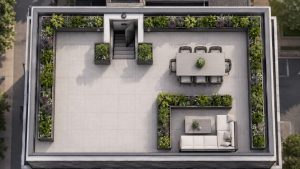
Perimeter boundary edge
The perimeter of a roof terrace is structurally the most efficient location for heavy planters. The edges of a flat roof slab are typically stiffer than the mid-span positions, so placing the heavier elements near the perimeter makes better structural use of the available capacity. Long trough planters along the boundary edge also provide privacy screening and wind attenuation for the terrace interior.
The Flat Roofing Alliance publishes technical guidance on pedestal terrace construction that covers load distribution principles for terrace systems over flat roofs. This is a useful reference for any contractor or specifier working on a rooftop terrace project.
Flanking the access point
The point where a rooftop staircase, ladder, or lift access emerges onto the terrace surface is a natural planter position. A pair of matching metal planters flanking the access point creates a composed arrival moment, signals that the space is designed, and in a commercial or hospitality setting sets the visual tone for the whole terrace experience.
Alongside a seating or dining area
Planters arranged in an L or U configuration around a seating area on a roof terrace create a sense of enclosure that makes the space feel sheltered and considered. Even two or three trough planters can transform an exposed rooftop surface into a space that people actually want to spend time in.
The planting in these positions should provide some visual privacy and wind attenuation without growing so tall or dense that it blocks the views that are usually part of why a rooftop terrace is desirable in the first place. Grasses, Phormium, lavender, and clumping bamboo all work well in this application.
Load-optimised positions over structural supports
For large or heavy planters, the best structural positions are directly over columns, loadbearing walls, or primary beams in the building structure below. A structural engineer can identify these positions from the building drawings and confirm what load can be carried at each point. On a project where heavy specimen planting is part of the brief, positioning large planters over columns can free up significantly more load capacity than trying to distribute them evenly.
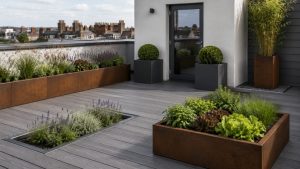
Benefits of a Metal Planter on a Rooftop
There are concrete, practical reasons why metal planters are the dominant planting solution on UK roof terraces. Here is the honest case for them.
- Lightweight aluminium reduces structural dead load: 4mm aluminium uses roughly half the dead load of equivalent steel before growing medium is added. On a weight-constrained roof slab, this is often what makes the difference between a scheme being feasible and not.
- Non-combustible for regulated buildings: Both aluminium and steel achieve A2-s1,d0 fire classification under BS EN 13501-1. On residential buildings above 18m and most commercial buildings, this classification is required for all external materials under Approved Document B.
- Frost-proof in all UK outdoor conditions: Metal planters do not crack in freeze-thaw cycles. On an exposed rooftop that may be unoccupied in winter, frost damage is never a concern with steel or aluminium.
- Any bespoke size without tooling cost: Because metal planters are cut and welded rather than moulded, any dimension can be fabricated without mould costs. A planter sized to fit the exact structural grid of a terrace subframe is as straightforward to order as a standard size.
- Consistent colour across the full scheme: Batch powder-coating ensures every planter in a scheme is in precisely the same RAL colour. This is practically impossible to achieve with timber, terracotta, or stone at reasonable cost.
- Maintenance-free over the terrace lifespan: Powder-coated aluminium planters need no annual treatment. An occasional wipe-down is all that is required for decades of outdoor use.
- Recyclable and sustainable: Aluminium is 100 percent recyclable without loss of quality. For projects with sustainability credentials or environmental assessments, this matters.
- Long service life: A properly specified aluminium terrace planter should last 30 or more years. A corten steel planter should last 40 or more years. Either specification comfortably outlasts the typical refurbishment cycle of a commercial building.
Metal Planter Installation Guide for Roof Terraces
The following installation sequence covers the standard approach for setting up metal planters on a pedestal-supported flat roof terrace. The principles apply to both residential and commercial rooftop applications.
Before you start: confirm the structural load
Have a structural engineer confirm the dead load capacity of the roof slab and the maximum total load at each planter position before any pedestal or planter is placed. Provide the engineer with the planter dimensions, the material specification, the growing medium specification, and a layout drawing showing all planter positions and approximate weights.
Step 1: Ensure the membrane is complete and tested
All planter and subframe work on a flat roof must start after the waterproofing membrane is fully installed, tested, and accepted. Any membrane repair or inspection access that might be needed in the future must be allowed for in the pedestal layout so that the membrane can be reached without dismantling the full terrace system.
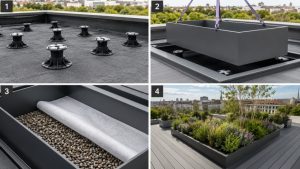
Step 2: Lay the protection layer and set pedestals
Lay a protection fleece or protection board over the membrane across the full terrace area. Place the adjustable pedestals at the positions shown on the layout drawing. Use a laser level or a long spirit level to set all pedestals to the same datum height, adjusting the pedestal head at each position. Lock each pedestal at the set height. Take particular care at planter positions, where the pedestal specification must be adequate for the concentrated loads.
Step 3: Install the subframe joists
Place the aluminium subframe joists on the pedestal heads, working from one corner systematically across the terrace. Secure joist-to-pedestal connections with stainless steel fixings. At planter positions, form the opening in the subframe by fitting double-joist headers on each side of the planter pocket. Check that the subframe is square using diagonal measurements before fitting any corner bracing.
Step 4: Position and secure the metal planters
For freestanding planters sitting on the finished terrace surface, place them in the specified positions after the surface finish is installed. Confirm the planter feet are sitting flat and the planter is level. For in-deck integrated planters, lower the planter body into the subframe opening before the surface finish is installed, securing the flanged rim on the subframe members. Confirm the rim height is correct relative to the finished surface level.
Step 5: Connect planter drainage to the roof drainage system
Run flexible drainage tubing from the planter base holes through the pedestal layer to the roof drainage outlets. Ensure a positive fall from the planter holes to the outlet with no trapped low points. The drainage from each planter must have a clear route to the roof drainage system so that overflow from the planters cannot pool on the membrane surface.
Step 6: Add growing medium and plant up
Add a 50 to 75mm drainage aggregate layer (lightweight LECA or perlite for rooftop use) to the planter base, cover with geotextile membrane, and fill with specialist lightweight container compost to 80 percent of the internal planter depth. Plant up following the planting specification. Apply 30 to 50mm of decorative mulch over the growing medium surface.
Step 7: Water in and verify drainage
Water each planter thoroughly. Drainage should begin from the base holes within one to two minutes of a full watering. Confirm drainage is flowing freely to the roof outlets and not pooling on the membrane surface beneath the planter. After the first significant rain event, walk the terrace and check for any areas of standing water.
| Annual maintenance: check planter drainage holes are clear of debris each autumn. From inside the building, confirm there is no evidence of moisture tracking under any planter position. Aluminium planters need no surface treatment. An occasional wipe-down with a damp cloth and mild detergent keeps the powder-coat finish looking sharp. |
What to Plant in a Metal Planter on a Roof Terrace
Plant selection for a rooftop terrace is different from a sheltered garden position. Wind is more intense at height. Direct sun is more intense in south-facing positions. Drought between rain events is more pronounced because container growing medium dries faster than garden soil. The right plants for a rooftop terrace are ones that can handle all three.
Best plant choices for UK roof terrace planters
- Calamagrostis ‘Karl Foerster’: Upright, architectural, wind-tolerant, and reliably perennial. One of the best-performing plants for UK roof terrace trough planters. Holds its form through winter and moves beautifully in wind.
- Fargesia murielae (clumping bamboo): The best screening plant for tall trough planters on exposed terraces. Wind-tolerant, non-invasive, and evergreen. Provides year-round privacy.
- Phormium (New Zealand Flax): Bold, spiky, and structural. Bronze-foliage varieties pair visually with corten steel planters. Tolerant of dry and exposed conditions.
- Lavender (Lavandula angustifolia): Drought-tolerant, fragrant, and reliable in sunny exposed positions. Well-suited to the free-draining conditions of a container on an exposed rooftop.
- Stipa gigantea: Tall ornamental grass with airy golden flowerheads in summer. Creates a semi-transparent screen and moves dramatically in wind.
- Agapanthus: Blue or white summer flowers. Evergreen strap leaves. Performs well in constrained container conditions. Does not need mollycoddling.
- Sedum and Sempervivum: Drought-tolerant, low-maintenance, and visually interesting in shallow roof terrace planters. The
Plants to use with more care on rooftops
- Running bamboo (Phyllostachys): Will eventually rupture container walls as rhizomes spread. Use only clumping varieties such as Fargesia.
- Large-leaved plants: Wind shred is a real problem for large-leaved species on exposed rooftops. Fatsia, large hostas, and giant ornamental grasses tend to look battered rather than designed in very exposed positions.
- High-moisture plants in dark planters in full sun: Dark-coloured metal planters in south-facing positions absorb more heat and dry out faster. Match moisture-hungry plants to lighter-coloured planters or position them in partial shade where possible.
Metal Planter for Commercial Roof Terraces
Commercial rooftop amenity terrace projects typically have three requirements that distinguish them from residential roof terrace schemes.
Fire compliance documentation
On commercial buildings and residential buildings above 18m, all external materials must be documented with their fire classification. Metal Planters Ltd can provide material certification confirming the A2-s1,d0 classification of aluminium planter bodies and steel subframe components for inclusion in the building’s fire compliance documentation package. This is a standard part of our commercial project delivery.
Batch colour consistency
On a commercial terrace where thirty or fifty planters are being specified in the same colour, visual consistency across every unit is not optional. A slight colour difference between planters that were ordered in different production batches is visible and looks like a procurement oversight. Metal Planters Ltd batch-powder-coats all units in a project order to guarantee absolute colour consistency.
Co-ordinated terrace system supply
Commercial roof terrace projects typically involve co-ordination between the waterproofing contractor, the structural engineer, the subframe installer, the terrace surface contractor, and the planting team. Metal Planters Ltd can supply the full system: planters, subframe, pedestals, drainage components, decking, and associated trims and fixings from a single supply contract. This simplifies procurement and eliminates the compatibility risk of sourcing components from multiple suppliers.
Browse the full system specification at the Metal Planters Ltd homepage or see the metal planter product range for detailed material and size options.
Terrace Planter Costs in 2026
Prices for metal roof terrace planters depend on material, gauge, size, and whether the planters are supplied as standalone units or as part of a complete terrace system. The table below gives indicative ranges for 2026 planning purposes.
| Planter / component | Material | Indicative price (inc. VAT) | Notes |
| Square cube 500x500x500mm | 4mm aluminium | £220 – £340 | Standard rooftop spec |
| Square cube 600x600x600mm | 3mm corten | £200 – £300 | Pre-weathered finish |
| Trough 1000x400x400mm | 4mm aluminium | £280 – £400 | Perimeter screening |
| Trough 1500x500x500mm | 4mm aluminium | £420 – £600 | Large boundary trough |
| In-deck planter 600x600x500mm | 4mm aluminium | £320 – £480 | With in-deck rim detail |
| Raised bed 1200x600x600mm | 3mm corten | £360 – £500 | Rooftop kitchen garden |
| Adjustable pedestal (per unit) | Polyprop / aluminium | £3 – £18 | Depends on fire rating |
| Complete rooftop terrace system/m2 | Aluminium full spec | £180 – £350/m2 | Pedestals, subframe, decking |
| Bespoke (any size, per unit) | Any material | POA | Quote within 24-48 hours |
Contact Metal Planters Ltd on 01245 922332 or at sales@metal-planters.co.uk to discuss your project and receive a specific quotation. We are happy to work through the specification with you at any stage of the design process. See the Metal Planters Ltd homepage or the planters product range for full product details.
Frequently Asked Questions
| What is the best metal planter for a roof terrace? |
| Aluminium is the best metal planter material for most roof terraces because it weighs roughly half as much as equivalent steel or corten before growing medium is added. On a weight-constrained roof slab this difference is significant. Aluminium also meets the A2-s1,d0 fire classification required for external materials on regulated buildings above 18m. For residential terraces where weight is not a constraint and the design calls for an organic finish, corten steel is a strong choice. |
| How much weight can a roof terrace hold for planters? |
| The dead load capacity of a flat roof slab is typically 1.5 to 2.5 kN per square metre for a standard residential roof extension, which translates to roughly 150 to 250 kg per square metre. A well-specified aluminium planter with lightweight container compost typically contributes 110 to 140 kg per square metre of footprint. Always confirm the specific capacity with a structural engineer before finalising the planter specification. |
| Do roof terrace planters need to be fire rated? |
| On residential buildings above 18m and on most commercial buildings, all external materials including planters must meet A1 or A2-s1,d0 fire classification under BS EN 13501-1. Both aluminium and steel planters meet A2-s1,d0 as standard. Timber, fibreglass, and most plastic planters do not meet this classification and should not be used on regulated external building zones. |
| Can I put planters directly on a flat roof membrane? |
| No. Metal planters must not be placed directly on a flat roof waterproofing membrane. Direct contact creates point loads that can damage or puncture the membrane over time and traps moisture between the planter base and the membrane surface. Always use adjustable pedestals between the membrane protection layer and any structure or planter above it. |
| What plants work well in roof terrace planters? |
| Plants that tolerate wind, direct sun, and container drought are the most reliable choices for UK roof terrace planters. Calamagrostis Karl Foerster, Fargesia clumping bamboo, Phormium, lavender, Stipa gigantea, and Agapanthus all perform reliably. Avoid large-leaved plants in very exposed positions and running bamboo varieties in closed containers. |
| How long do aluminium roof terrace planters last? |
| A quality powder-coated aluminium metal planter should last 30 or more years on a UK roof terrace. The aluminium does not rust. The external-grade polyester powder coat is rated for 20 or more years without fading or peeling. Annual drainage hole clearance is the only maintenance required. |
| Are bespoke sizes available for roof terrace planters? |
| Yes. Metal Planters Ltd fabricates all planters in-house in Chelmsford, Essex. Bespoke sizes are our most common order type and carry no significant price premium over standard sizes. Provide your dimensions and we will quote within 24 to 48 hours. Most bespoke planters are delivered within three to four weeks. |
| What is the difference between a freestanding planter and an in-deck planter? |
| A freestanding planter sits on top of the terrace surface on its own feet. An in-deck planter is integrated into the terrace subframe so that its top rim sits flush with or just above the finished terrace surface. In-deck planters require the planter dimensions to be co-ordinated with the subframe layout from the start of the design process. They produce a more seamless, architecturally considered result but require more planning. |
Conclusion
Choosing the right planter for a rooftop project takes more thought than most people expect going in. The material choice, the weight calculation, the fire compliance, and the drainage all need to be resolved before a planter order is placed. Get these things right and the result is a roof terrace that looks exactly as designed and performs reliably for decades.
The best roof terrace planters UK projects use aluminium for the primary planting scheme: it is lightweight, fire compliant, maintenance-free, and available in bespoke sizes that can be designed around the terrace structure rather than forcing the structure to accommodate a standard product. For schemes where the organic character of corten steel suits the design intent, and where the structural dead load budget allows it, a mix of aluminium and corten is an effective approach.
Metal Planters Ltd designs and supplies complete metal planter and terrace systems from our workshop in Chelmsford, Essex. Contact us on 01245 922332 or at sales@metal-planters.co.uk, visit the Metal Planters Ltd homepage, or browse the planters product range to start the conversation about your rooftop project. Find us on google maps.